
The Two-Question (E-F) Political Quiz
There are some basic questions in politics (since maybe Plato):
Who should govern? (How many?)
What (how much) should be governed? And what, if anything, should never be governed?
In theory, from the 1776 Declaration, Americans answer these questions first with Democracy: rule of, by, & for the people with the “consent of the governed”; secondly, ALL governments are limited to respect the Equal Rights of All and to never violate the natural rights to “life, liberty, and the pursuit of happiness.”
Still there are two questions that reveal basic political differences throughout history, including between Americans today. (Jefferson labeled these natural parties as “Whig” and “Tory.”) Two questions underlie most political attitudes and identify long-term political friends and foes. Just as a “house divided cannot stand”, people cannot long endure in the same party when some want government bigger and others want it smaller, and the same rule applies to wealth inequality.
Answering these two fundamental questions will find your political direction. (See FIG_W2QQ1)
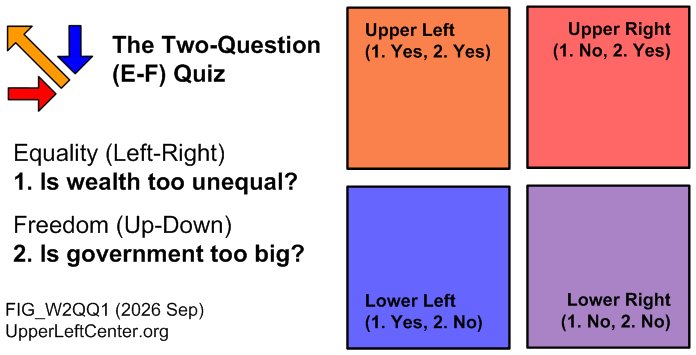
Two dimensions with four quadrants could not possibly explain ALL political differences; and no such absurd claim is made. The claim is that these two political conflicts over: (1) wealth inequality and (2) size of government are fundamental and the most important historically.
Like a compass, the Two-Question Quiz (2QQ) points the direction to identify like-minded travelers. To state the obvious: those who believe government too big and/or wealth too unequal should not share a ride with those traveling the other direction! This can also separate good policies from bad ones (heading the
wrong way) like wheat from chaff.
A compass is not a map. It tells which direction to move assuming we know where we are and wish to go. (Also handy is a good map.) The quiz is deliberately worded for that purpose. Given the current size of government and wealth inequality, the 2QQ asks whether these are already too much– or not. It is NOT
asking whether there should be NO government or whether all wealth should be equal. To misrepresent the questions in that manner is like being given a compass and told it points true north (to the North Pole), and then throwing it away because that’s not where you want to go!?
Even though limited, knowing the direction to travel (from a compass or the Two-Question Quiz) is often worthwhile enough. If we are tasked to set the thermostat in a room of people; we don’t need to know every person’s ideal room temperature or even the current room temperature; we need merely to ask everyone: is it too hot or too cold?
In similar fashion, to identify the will of the majority, there is no need to know every person’s ideal size of government or their ideal degree of wealth inequality. If we know the ideal for everyone so much the better, but that requires much more than a simple two-question quiz. For political purposes, it is not necessary, but the direction of movement is absolutely necessary! And in politics, those who wish to move against the majority have a great interest in preventing the right questions from even being asked. It may then become far too clear what the vast majority want done.
Some will reject the 2QQ as too simplistic while ignoring the flaws in the one-dimensional Left-Right Spectrum so widely used. How can two dimensions be too simple, if one dimension is accepted, widely used, and never even defined?!
The 2QQ is already a major improvement in clearly defining Left-Right. The Left believes wealth is too unequal. The Right does not. This overlooked benefit solves a basic problem in the customary political misuse of poorly defined Left-Right labels, too often never defined at all!
Hence the crucially important lead-off question: is wealth too unequal? The question is deliberately asked first because it was the earliest difference in political matters historically, since Aristotle considered democracy (for the poor) and aristocracy (for the rich) and the Romans divided plebians from patricians.
Defining Left-Right based on wealth inequality is also the original meaning since the French Revolution. You would think “conservatives” would at least preserve that tradition. (See FIG_WLR1)
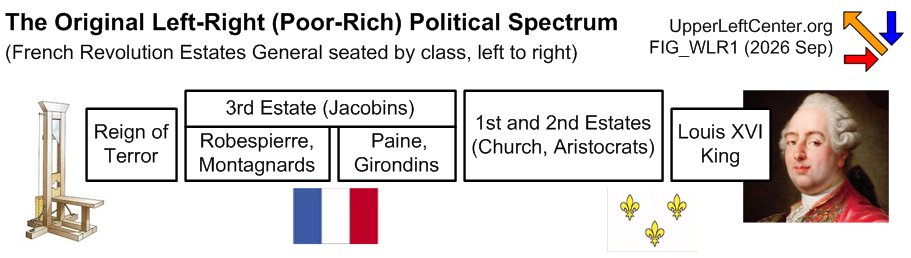
The original definition for Left-Right was class-based, poor peasants versus wealthy aristocrats. The 2QQ is based on this original class-based orientation.
If these are not the two most important questions, then what other question is more important? At times, the question of war has been primary and yet it also involves the scope of government in the extreme. In America, slavery was once the primary divisive question and mostly a matter of racial inequalities, though obviously all those black slaves were poor.
For too many Americans the most important political questions are: do you prefer Biden or Trump? Are you conservative or liberal? These questions really want to know: are you with my tribe or against it? It is then no wonder our two party system (TPS) becomes an increasingly polarized tribal warfare!
The Equality-Freedom (E-F) Political Map
Measuring political differences in two dimensions (See FIG_WEF1)
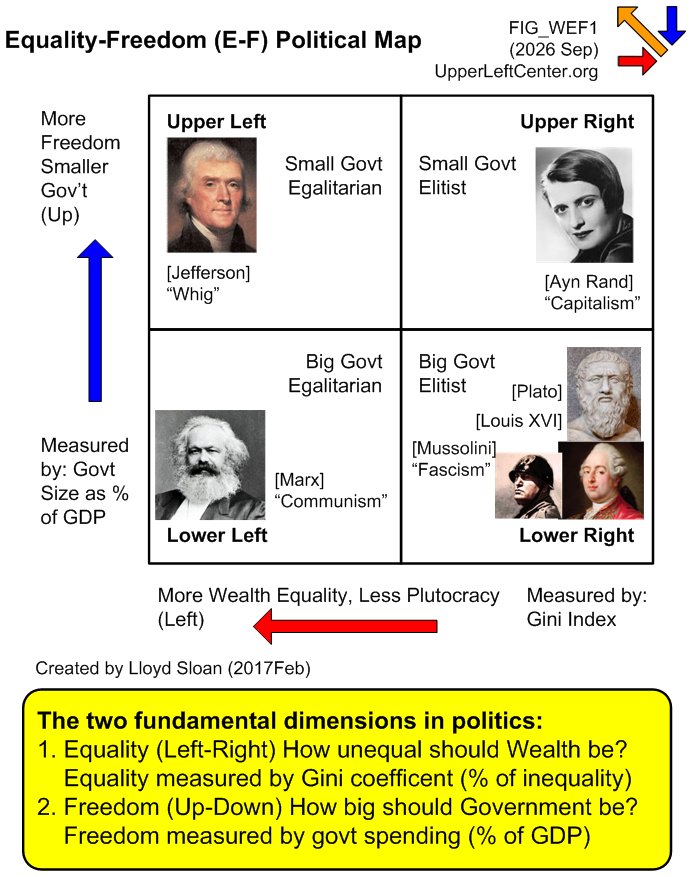
The E-F Map is based upon the same two dimensions (Equality and Freedom) as the four-quadrant 2QQ. But the E-F Political Map is measurable, unlike other political maps critiqued elsewhere.
Because the two dimensions can be objectively measured, it is possible to make comparisons between American states and between countries. It is also possible to measure trends and show the long-term American decline into fascism in the past 75 years, specifically the growing size of government and
greater inequality shown together in one graph rather than separately in two. This graph reveals the significance of the E-F Map. NO other political spectrum or map can objectively measure such trends.
(See the E-F time series graph “Lower-Right Shift in the United States (1947-2025”)
Some will quibble at measuring freedom by the Gov % of GDP (reversed from 100%); Milton Friedman used this approach with a graph [Chapter 2] in “Tyranny of the Status Quo” (1984) and Reagan compared it to “a law of physics: As government expands, liberty contracts.” [Farewell Address, 1989Jan11]
Others may find the (U.S. Census reported) Gini coefficient too obscure or quibble it measures income rather than wealth inequality. These quibbles are not worth much fuss. Certainly not when compared with alternative political maps entirely incapable of any objective measurement.
The Depressing Trend to Lower Right Fascism in America (1947-2025)
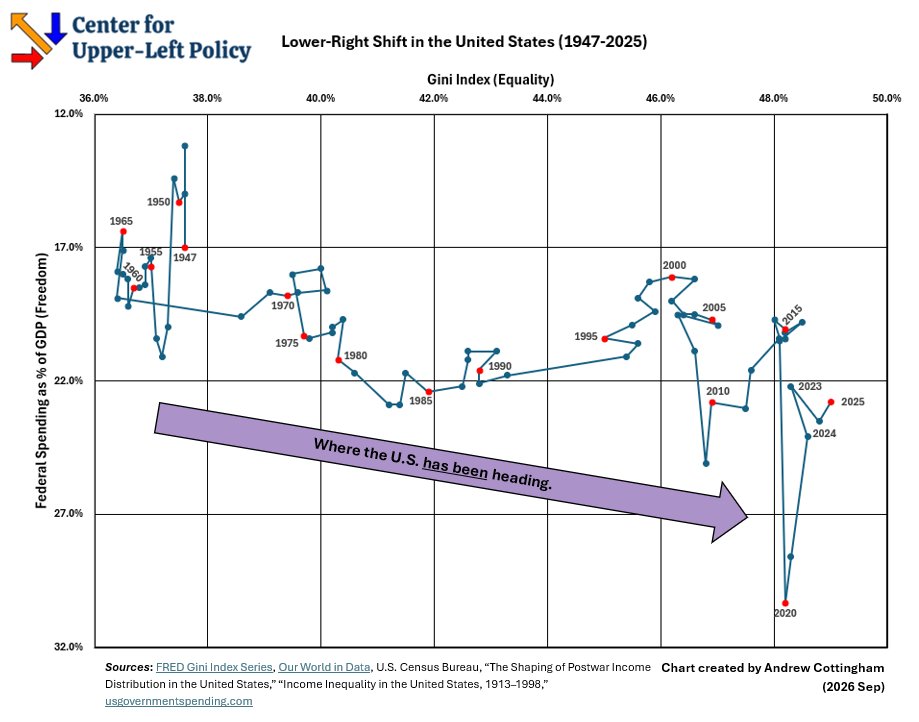
This should quickly debunk the wishful dogma behind so many “progressive” welfare-state ideas: if bigger government were the solution to inequality, we should be seeing things a lot more equal by now!
Fascism in the middle and Jefferson’s Whig-Tory Politics
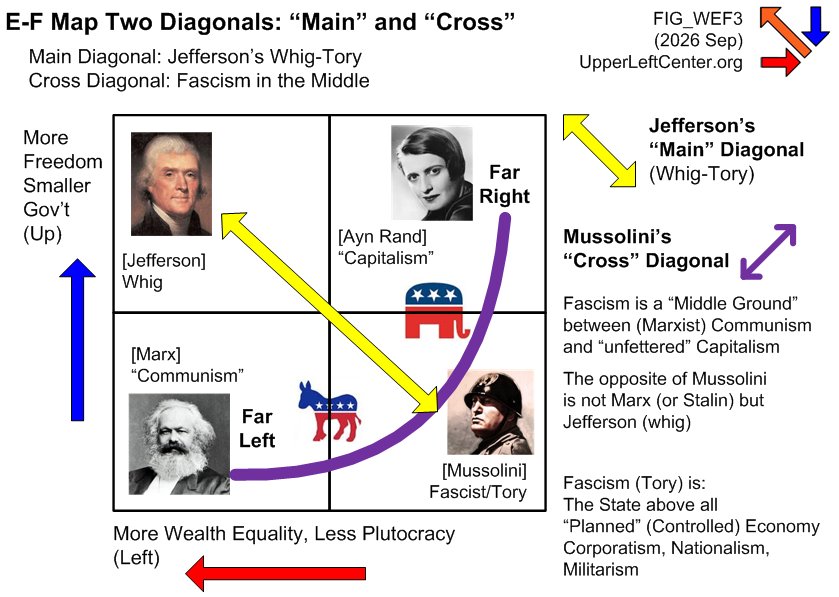
Mussolini and Jefferson are difficult to understand and correctly locate on the customary Left-Right spectrum or other 2D political maps. Mussolini considered fascism as a middle ground between Marxist communism (no private property) and unfettered capitalism (private property is sacred.)
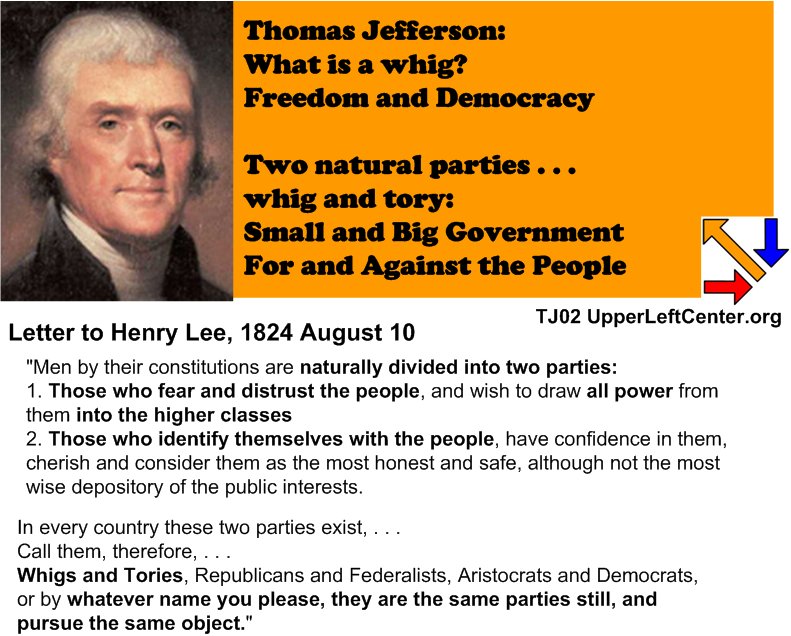
Jefferson was before Industrialism, Marxism, and Fascism. For him the basic political struggle was between two natural parties: whigs and tories. (See Fig_TJ02)
Jefferson was a devout believer in minimal government and also in trusting (“identifying with”) the people. His view of democracy is actually deeper than the shallow view of mere majority rule.
Democracy is taken directly from the Greek to mean “rule by the people”; this is too easily reduced to what Tocqueville called “a tyranny of the majority”, but Jefferson took it more literally. The “rule of the people” means people run their own lives. Rather than being associated with lower left socialism it is then closer to an upper left “classical liberal” small government.
The E-F Map illustrates both Mussolini’s and Jefferson’s political frameworks as Diagonals. The upper-left to lower-right forms a main diagonal of Jefferson’s whigs and tories. Mussolini sees lower-right fascism in the middle between lower-left communism and upper-right capitalism.
(See FIG_WEF3)
In conclusion
The Equality-Freedom (E-F) Map resolves problems in the L-R spectrum and three alternative 2D political maps. (See the later section: “Critique: Other Political Maps”)
The E-F Map is both well-defined and measurable. Both the traditional Left-Right (Gini index) dimension and the additional Up-Down (Gov % of GDP) dimension are objectively measured. The horseshoe theory is accommodated within the E-F Map; authoritarian regimes are closer, not polar opposites: Stalin (lower left) and Hitler (lower right). The model also illustrates Mussolini’s middle ground of fascism and Jefferson’s two natural whig-tory parties.
The E-F 2QQ fixes the excessive questions for the quizzes of the Political Compass and Nolan chart. Rather than being less accurate, it is the opposite. It avoids the political dysfunction and subterfuge of grouping people together who literally disagree completely on over 60 questions!
The E-F definition of Left-Right is historically consistent with the (original) usage since the French Revolution. The Political Compass (and Mitchell) get this wrong. The conservatives and the libertarian-biased (freedom-only) Nolan chart ignore wealth inequality and class differences entirely.
The E-F Map places Freedom above Tyranny, as it should be.