
A critical survey of political maps, or what’s wrong with left-right?
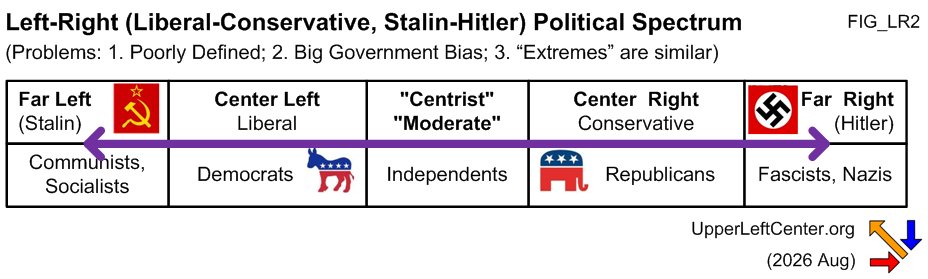
There are several problems with the Left-Right (Liberal-Conservative, Stalin-Hitler) political spectrum commonly taught in American schools and used by American journalists.
(See FIG_LR2)
1. The L-R spectrum is not well-defined. What is actually being measured? The labels are often used merely as tribal-warfare name-calling, such as, “leftist-extremist” or “far right-wing”.
2. The L-R spectrum has a big government (progressive) bias; Small government positions are left out. In theory, the smallest government (anarchy) would be furthest from BOTH Hitler and Stalin, which then absurdly makes anarchy a “centrist” position!?
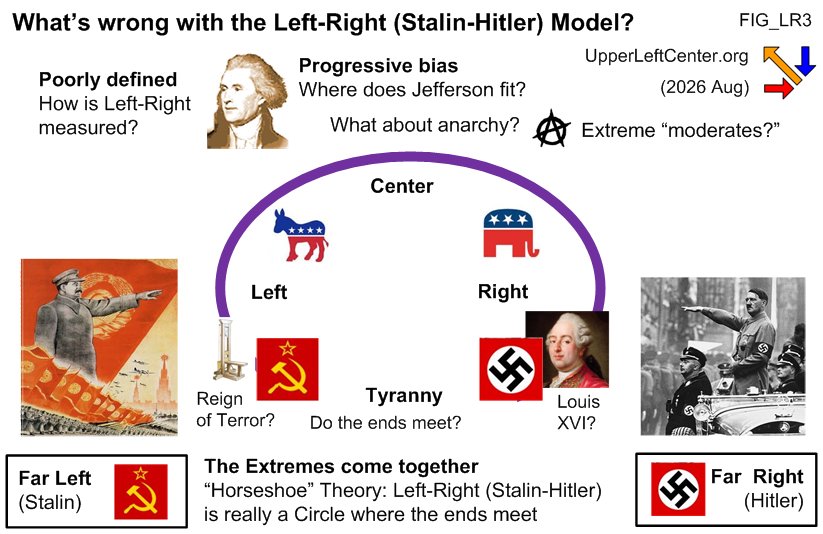
3. The two “extremes” are closer to each other than either is from the “middle.” The so-called horseshoe theory (credited to Jean-Pierre Faye in 1971) bent the line so the ends meet, resembling a horseshoe. This sees the problem, without fixing it.
FIG_LR3 illustrates these problems and also the so-called horseshoe theory; the curved nature of the horseshoe shows the need for two dimensions.
Other Political Maps (In two dimensions: Beyond Left-Right)
There are dozens of two-dimensional models developed to improve the broken and over-worked one-dimensional Left-Right spectrum. Some took considerable effort to include many (30-100) colorful political labels; these might be useful as a glossary (not a map) if they only included better definitions for the terms they use: liberal, progressive, conservative, libertarian, authoritarian, collectivist, individualist, social, economic, personal, tough-minded, tender-minded, traditionalism, mutualism, communism, socialism, fascism, capitalism, and more! These are real examples of labels taken from a plethora of political models and websites. (One graph had almost 100 political labels crammed into its two dimensions!)
One general criticism applies to most two-dimensional (2D) maps: the X-axis and Y-axis are not well-defined, and more specifically, they are not measurable. A map implies some measurement of distances between different places. What is the political “distance” between Jefferson and Ayn Rand? How is this measured? To be useful, this needs to be reasonably clear.
Another criticism applies to using lengthy quizzes to produce a misleading impression of measurement. For a two dimensional map, it is fundamentally wrong to have more than two questions. The extra questions are either redundant or require extra dimensions. If the questions are correlated (most likely) then reduce the number. If the questions are not correlated (independent), then more than two dimensions are needed.
Three 2D maps are worth mentioning as specific examples: The Political Compass, the Nolan-Libertarian Model, and the Mitchell “8 Ways” Arche-Kratos Diagram.
The Political Compass
The Political Compass is the best known and worst offender. It traces back to July 2001 with acknowledged intellectual influences from Wilhelm Reich and Theodor Adorno. The criticism of the PC will also apply to the many similar copycat approaches.
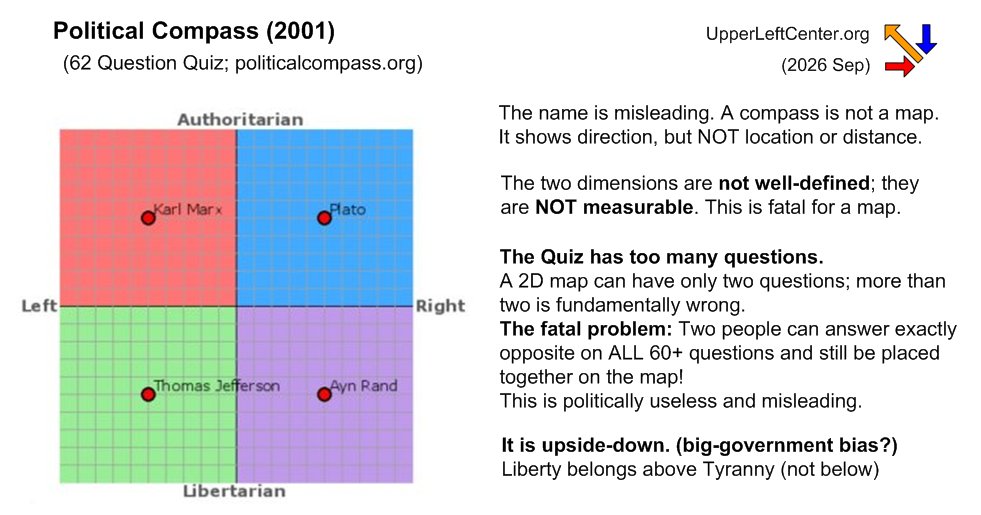
In theory a compass is only for direction. It points north, but it does not measure distance to the North Pole. It can tell us which way to travel, but not how far is left to go.
The deeper problem is the poor definitions for the X-axis and Y-axis. According to the website:
Left-Right is “certainly fine for discussing economics” but is “wrongly used to describe social attitudes.” “That’s why we added a social scale.” The quadrants “are not separate categories, but regions on a continuum”.
The new Up-Down dimension (social scale) is then “defined/labeled” as authoritarian vs. libertarian. But the distinction between social and economic matters is unclear. Especially when Left-Right is “defined” to mean how to “run” the economy: (left) government controlled or (right) free markets. This is actually the same distinction of authoritarian and libertarian!
And such a definition for Left-Right is historically wrong; Louis XVI and the old regime (the original right) favored “mercantilism” and opposed “laissez faire” economics! THEIR definition for Left-Right was class-based, poor peasants versus wealthy aristocrats.
Given the arbitrary (economic-social) distinctions in the two political dimensions, a deceptive sense of measurement is created by a lengthy quiz with 62 questions in 6 different sections. The questions are statements upon which to agree or disagree, such as, “The enemy of my enemy is my friend.” How useful can this be when Robespierre and Louis XVI might easily agree on that much!?
The excessive questions expose a hidden and fatal flaw: two people could disagree on every one of sixty statements and STILL be placed next to each other on the PC map! People are misled to believe they are political neighbors where they are actually polar opposites. This is absurdly misleading, at best, and utterly useless for rational political purposes.
Lastly, the Political Compass is upside-down. Liberty belongs above Tyranny, not below it. Booker T. Washington wrote “UP from Slavery” not “Down” from Slavery. Granted the orientation is arbitrary (like putting the northern hemisphere above the southern), but for those with a pro-freedom small-government bias, freedom is the upper quadrants and big-government is the lower quadrants. Not true for those with a progressive (authoritarian) bias.
The Libertarian “Nolan” Chart and Smallest Political Quiz
The first well-known two-dimensional political map (known as the “Nolan Chart”) is from the article “Classifying and Analyzing Politico-Economic Systems” by David F. Nolan and published by “The Individualist”, 1971 January. A 10 question quiz was later developed (circa 1987) by Marshall Fritz and promoted widely by the Advocates for Self-Government.
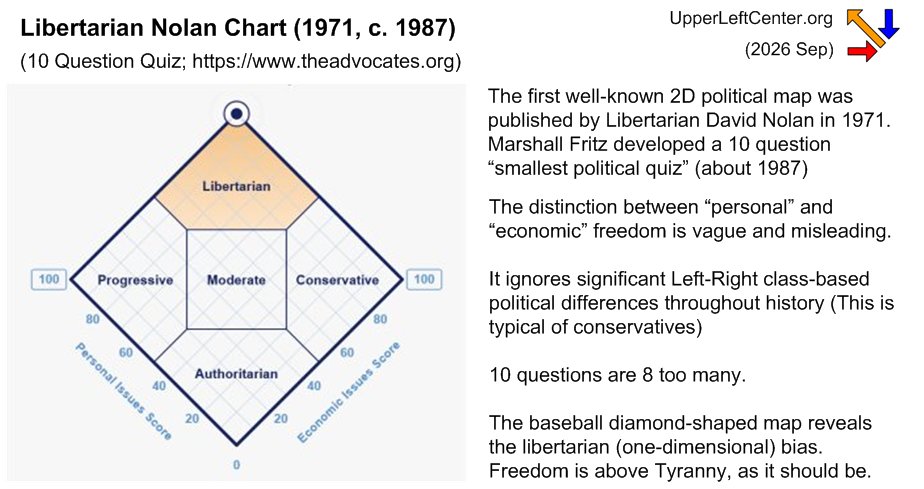
The axes are based on a rather dubious distinction between “economic” and “personal” freedom. All economic freedoms are personal, and personal freedoms are worthless without economic freedom. The diagram is really one-dimensional (not two); it is essentially an Up-Down diagram that measures support for several issues of liberty and individual rights.
Is prostitution a personal freedom or an economic freedom? What about gun ownership? Is the right to use marijuana so different than the right to buy it? Freedom of speech and press so long as it’s not an advertisement in a newspaper? For years American Libertarians have described themselves as “socially liberal and economically conservative”; this markets better than “as anarchistic as possible on a wide range of issues.”
The Quiz is mostly useful to identify people who are strongly “libertarian.” Those closer to the top are the more “purely” libertarian. The number of questions then becomes helpful. This would also be true for other lengthy quizzes if only their dimensions and questions were clearly directed in the way libertarians direct all their questions towards freedom and opposition to government coercion.
The more questions in the quiz, the more misleading are the results for those in the middle. People in the “moderate” middle could answer all the questions exactly opposite and still be placed next to each other; however, the ONLY way to reach the “pure” tip-top is to answer all the questions the pro-freedom way. This is true for all other political quizzes, including the 62 question Political Compass. (The PC problems are beyond the tiresome number of questions, but the number hides the other problems.)
The Nolan Chart pro-freedom orientation is openly transparent. The unique diamond-shaped map reinforces the bias by placing liberty at the tip-top. The mistake is ignoring historically important Left-Right class differences entirely! The French Revolution never happened and neither did the Houses of Lords and Commons or Roman patricians and plebians. If Marx over-estimated the class struggle as everything, Libertarians under-estimate class struggles as nothing.
Despite its flaws the Libertarian Nolan Chart deserves praise for being the first to introduce two dimensions into politics, adding Liberty and placing it on top. The “Smallest” Political Quiz was also the first of its kind; ten questions are eight too many, and yet this has remained the smallest for years; others erroneously added even more! The Political Compass got it up over sixty questions and turned the pro-freedom bias upside-down, but it did revive Left-Right and acknowledged the French Revolution, even if somewhat poorly.
Mitchell “8 Ways” Arche-Kratos Diagram
In “Eight Ways to Run the Country: A New and Revealing Look at Left and Right” (2007) Brian Patrick Mitchell defines a political diagram in two dimensions: “Arche” and “Kratos” (Rank and Force); similar to the E-F Model, Arche is like the Left-Right Equality attribute and Kratos is like the Up-Down Freedom attribute.
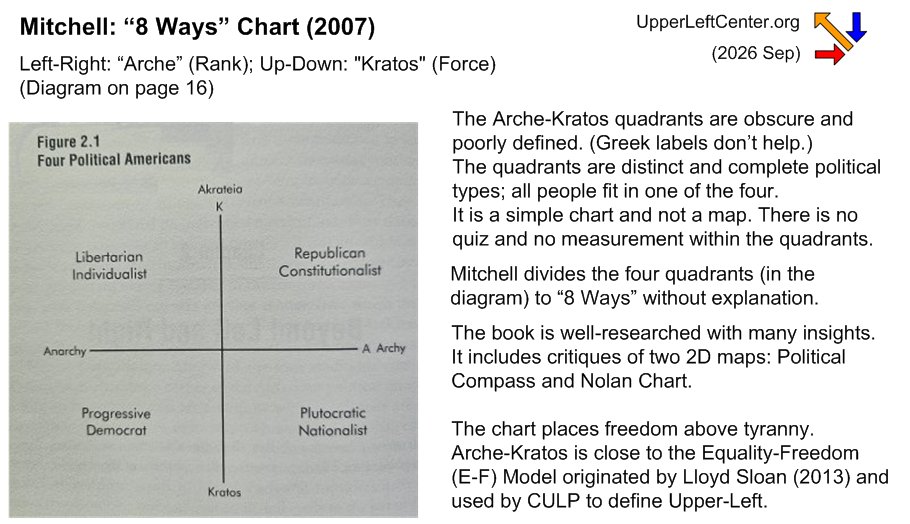
In the Preface (page x) the book promises a “conceptual framework” and a “new political compass” and “a few new terms”; It does not do away with Left-Right, but instead better “defines the Left and Right” and “adds a whole new dimension to explain what left and right can’t.” This is exactly what is needed. (The E-F Map delivers that same promise.)
The dimensions of Arche and Kratos (Rank and Force) are both obscure and somewhat poorly defined. (Perhaps being a Greek scholar might help.)
Mitchell (page 9) defines “Arche” as “the concept of rank” and “Kratos” as “the use of force”, especially government use of force, but admits “this distinction is not always evident. In the ancient world . . . Rank entailed the right to use force.” In the writings of Plato and Aristotle, the concept of limited government is missing. The focus is on the best form of government and “who should be sovereign.” Once that is decided, there is an absolute right to rule.
Mitchell sees anarchists as radical egalitarians rejecting all relationships of power, both Church and State. Kratos (Force) is based on government power, and Arche (Rank) is based on Church authority. From page 11: “The modern age might well be called the age of anarchy. It began around 1500 with a rebellion against hierarchy (the rule of priests), which led in time to a rebellion against monarchy (the rule of kings)” It seems strange to consider a time of two world wars and brutally totalitarian governments to be an “age of anarchy.”
Mitchell (page 12) traces four American political traditions using this Arche-Kratos distinction.
So the four quadrants (“8 Ways”) are defined based upon whether people rejected or accepted either government power or religious authority. The Left rejects Church authority/rank. The Up rejects Government force.
Mitchell’s four quadrants are categorized as:
Upper-Left: Libertarian Individualist (Small Government, Secular)
Divides into: The Radical; The Individualist
Upper-Right: Republican Constitutionalist (Small Government, Religious)
Divides into: The Paleolibertarian; The Paleoconservative
Lower-Left: Progressive Democrat (Big Government, Secular)
Divides into: The Communitarian; The Progressive
Lower-Right: Plutocratic Nationalist (Big Government, Religious)
Divides into: The Theoconservative; The Neoconservative
This is close to the Equality-Freedom (E-F) Model; The Up-Down dimension is essentially the same. Government Force is simply the negation of Individual Freedom, and Mitchell places Freedom on top and Government “Kratos” on the bottom. The Left-Right dimension is the difference. The E-F model is based on wealth inequality and not religious hierarchy.
Mitchell states (page 3) the Left-Right opposition “has been around since the French Revolution” but never much in America “until the early 20th century.” By the Cold War (page 4) Americans viewed Left-Right as “more or less government”. “The Left was collectivist; the Right was individualist.” This American conservative usage contradicts the original usage: The Leftist French revolutionaries opposed the big government of Louis XVI and the aristocrats on the Right.
The book also includes an informative history and solid criticism of two popular 2D political maps: The Political Compass (Freedom below) and the Nolan Chart (Freedom above)
The Compass was influenced by a psychological approach to political differences pioneered by Theodore Adorno and other authors of “The Authoritarian Personality” (1950); Following this psychological approach, Hans Eysenck put forth the first known 2D political scheme in 1964, adding the Up-Down dimension of Authority-Liberty (Tough-Minded over Tender-Minded with Freedom on the bottom) [Mitchell, pages 4-5]
Mitchell fails to see many problems with the Compass but does correctly identify one problem: the “identification of Left and Right with economic freedom”; “This defies the historical origin of the Left-Right difference.” The King of France was not laissez-faire, but mercantilist.
Mitchell also finds the key flaw in the 1970 Nolan chart promoted by Libertarians based on their quick characterizations of conservatives wanting “to control personal behavior but not the economy”, while liberals wanting “to control the economy but not personal behavior.” There are now too many exceptions to that rule, even if it were true in 1970.
Granting the “Nolan chart was a definite advance in thinking” yet politics is not “easily divided between the personal and economic.”