America was Founded on (Upper-Left) “Whig” Principles
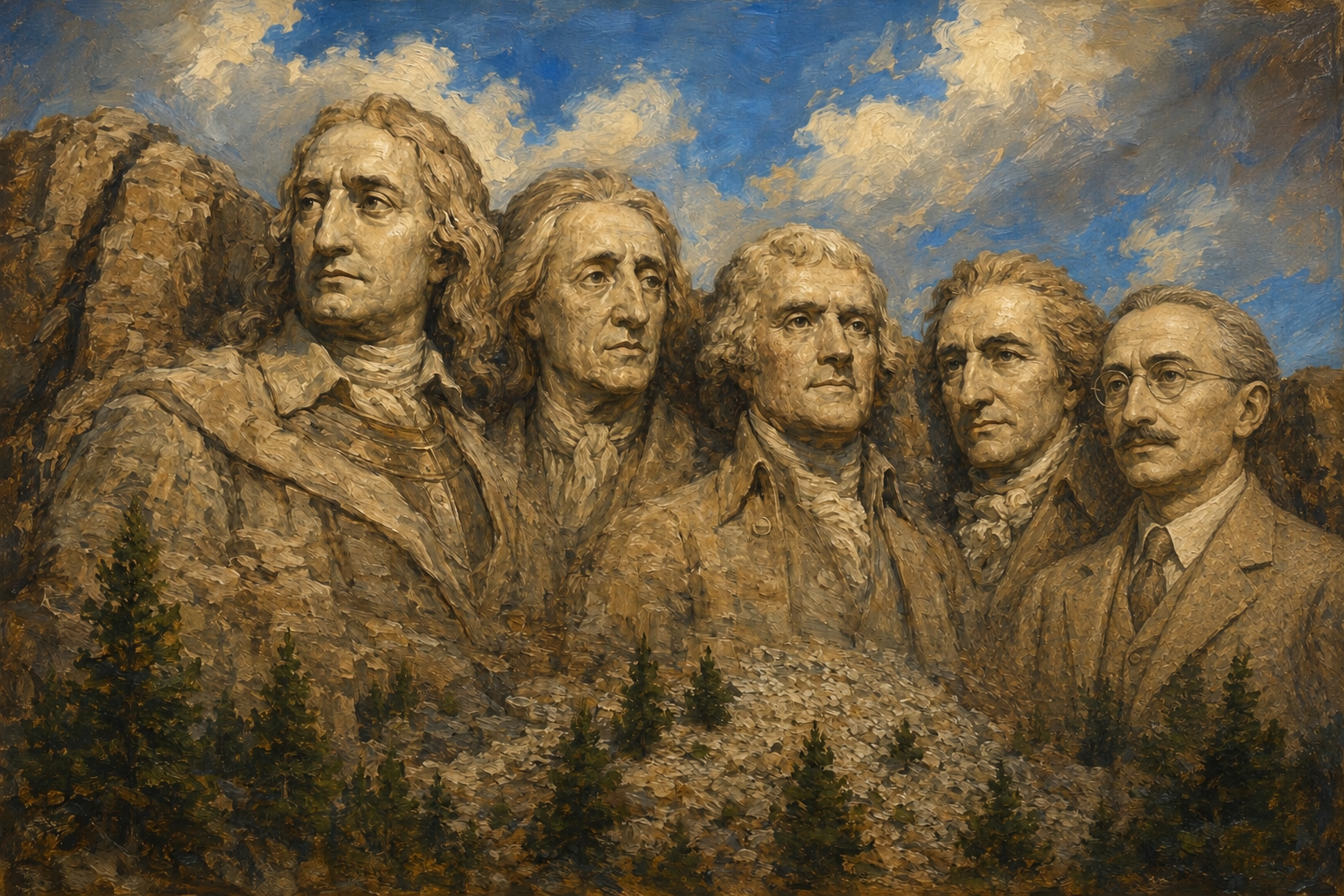
The Upper-Left Whig Mt. Rushmore Five (from left to right): William of Orange, John Locke, Thomas Jefferson, Thomas Paine, Friedrich von Hayek
By: Lloyd Sloan & Bob Wittmann (February 2024)
The 1776 American Declaration of Independence is the foundation for small limited government to secure the equal rights for all. These self-evident truths were known as “whig” principles by America’s founding generation, such as Jefferson and Paine.
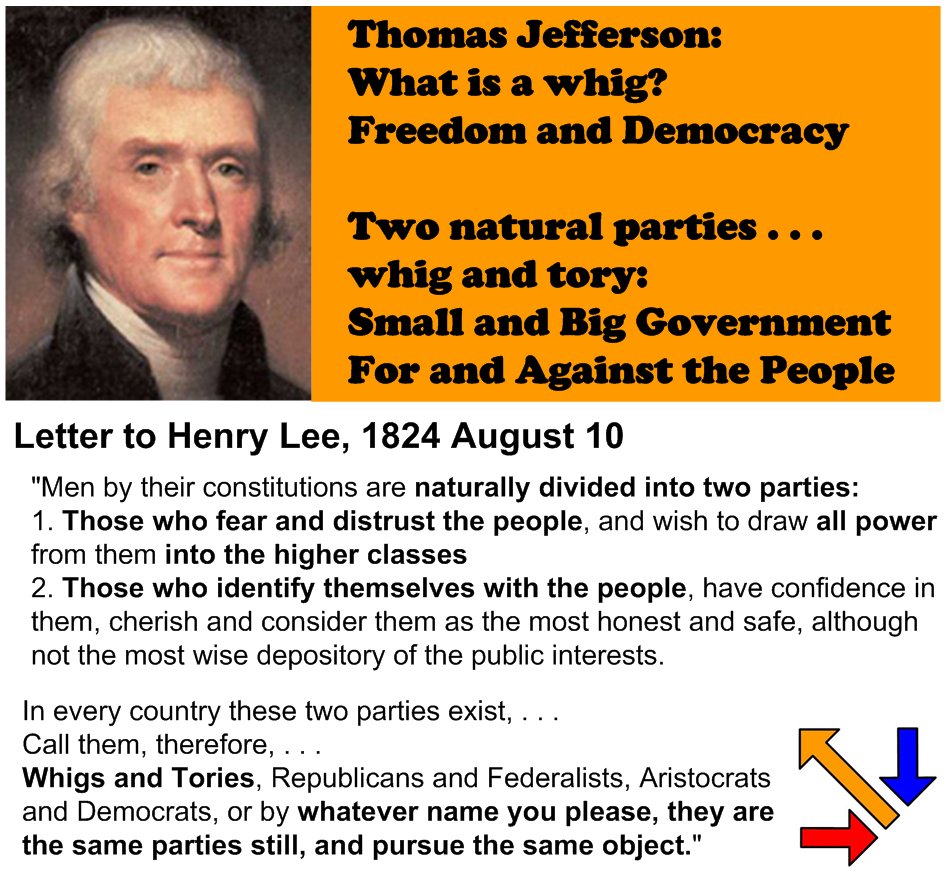
Thomas Jefferson later wrote that people are “naturally divided into two parties: whig and tory. The whigs “identify themselves with the people.” The tories “fear and distrust the people” and “draw all power from them into the higher classes.”
The Democratic Party was founded upon “whig” policy: Andrew Jackson staunchly opposed the National Bank, which privileged the Eastern elite. (Jefferson had earlier opposed the Bank as unconstitutional; Hamilton argued the opposite.)
The Whig Party formed in opposition to Jackson, but the name was misleading except for its lukewarm opposition to slavery (the original American sin); then in 1854 the Whigs betrayed the anti-slavery cause with the Kansas-Nebraska Act, undoing the Missouri Compromise that had prohibited further slavery expansion in 1820. The Republican Party formed as a result, eventually leading to civil war and the thirteenth amendment (abolishing slavery.)
Much less remembered the Republican Party enacted one of the great “upper-left” policies in American history: the Homestead Act of 1862. This provided government land to pioneer farmers (the bulk of America’s lower and middle classes). It handed government land to lower-income small farmers. It promoted individual self-reliance, not welfare-state dependence.
America should consciously recreate the conditions that forged the original frontier democracy: a middle-class society of equal and self-reliant members with little assistance or interference from the governing class. Since the Frontier closed (officially in 1890), America has seen an (industrialized) “Tory” counter-revolution against these founding “Whig” principles!
Why the Upper-Left should be labeled whigs?
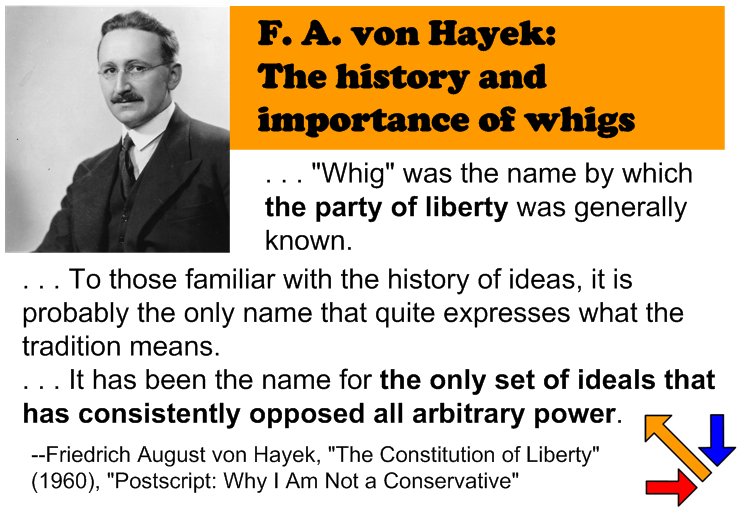
CULP uses the labels “Upper-Left” and “whig” and “orange” to mean essentially the same political direction and policies. The label “classical liberal” is basically equivalent and others still prefer its use. CULP avoids the phrase “classical liberal” for two reasons: (1) it is rather awkward (2) “Classical” liberalism eventually drifted into lower-left socialism; it was unable to find small-government solutions to the wealth inequality problems caused by industrialism (J.S. Mill and Bertrand Russell being examples)
Why the Upper-Left whigs use the color orange?
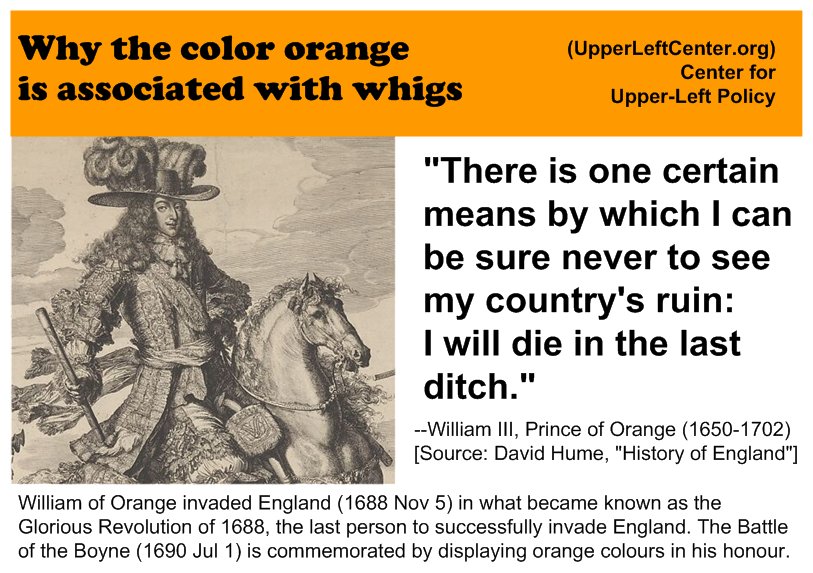
CULP embraced the color orange for the silliest of reasons: William III of the 1688 Glorious Revolution was known as William of Orange. The 1688 “whig” revolution initiated the reign of William and Mary and produced the English Bill of Rights (1689); John Locke’s Second Treatise on Government (1690) compiled these “whig” principles of government to justify that revolution.