By: Andrew Cottingham
University of Evansville Alumni (2022)
Date: March 30th, 2024
A new poll commissioned by Lloyd Sloan, Harvard ’78 graduate, and conducted by the TechnoMetrica Institute of Policy and Politics between February 28th and March 7th, 2024, strengthens the case for a new political map. This political map, which was first conceptualized by Sloan in 2013 and has since been developed, is referred to as the E-F Model or E-F Grid. The name E-F is derived from two key principles in American politics, those being equality and freedom, which are then measured, according to Sloan, by wealth inequality (equality) and size of government (freedom).
The Standard “Left vs Right” Model:
Before we examine the case for replacing the current political spectrum, which is taught nationwide by professors in every undergraduate political science program, we must first ask ourselves these questions. Why is the current model sufficient, why is it not, and how can it be improved?
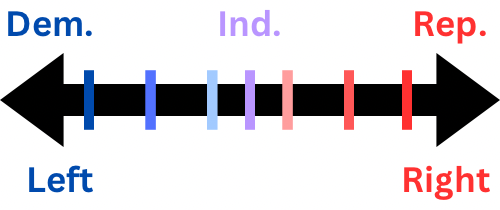
In undergrad, we are taught that the political spectrum is linear, which is pictured here, and that it is divided into 7 categories amongst Democrats, Republicans, and Independents. In the classic “Left vs Right” model, you have strong Democrats, weak Democrats, and Democrat-leaning Independents on the left; meanwhile, you have strong Republicans, weak Republicans, and Republican-leaning Independents on the right.
While this model showcases a surface-level understanding of political party identification, neither does it truly does explain why individuals identify themselves on the left or the right, nor does it explain why Independents identify themselves in the middle. Additionally, this model also fails to represent people who identify with third parties altogether. This is where the current Left-Right model and other models such as the Political Compass are greatly insufficient, and where the E-F Model is more sufficient.
Introducing the E-F Model:
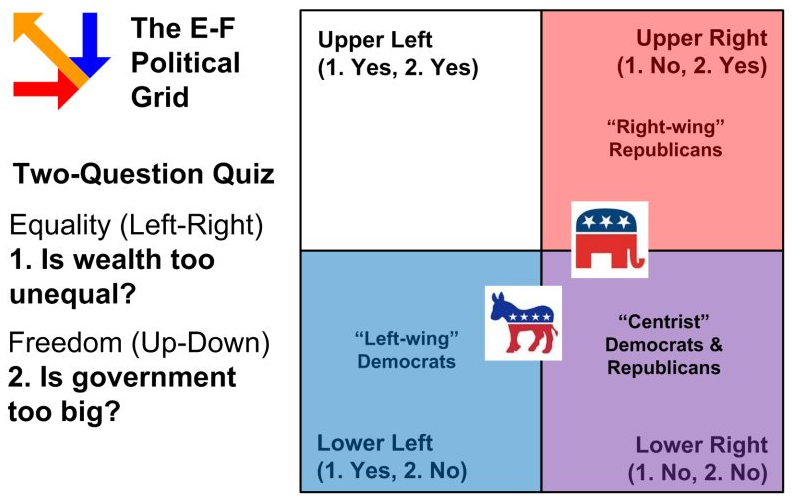
Unlike the Political Compass, which lists over 60 questions, the E-F Model is based on two simple yes/no questions, where the core values of equality and freedom are tested. Additionally, while the Political Compass places freedom down, the E-F Model places freedom up. As previously mentioned, this model measures one’s opinion on equality (wealth inequality), and freedom (size of government) by asking these two questions below.
Is the wealth in the U.S. too unequal?
Is the U.S. government too big?
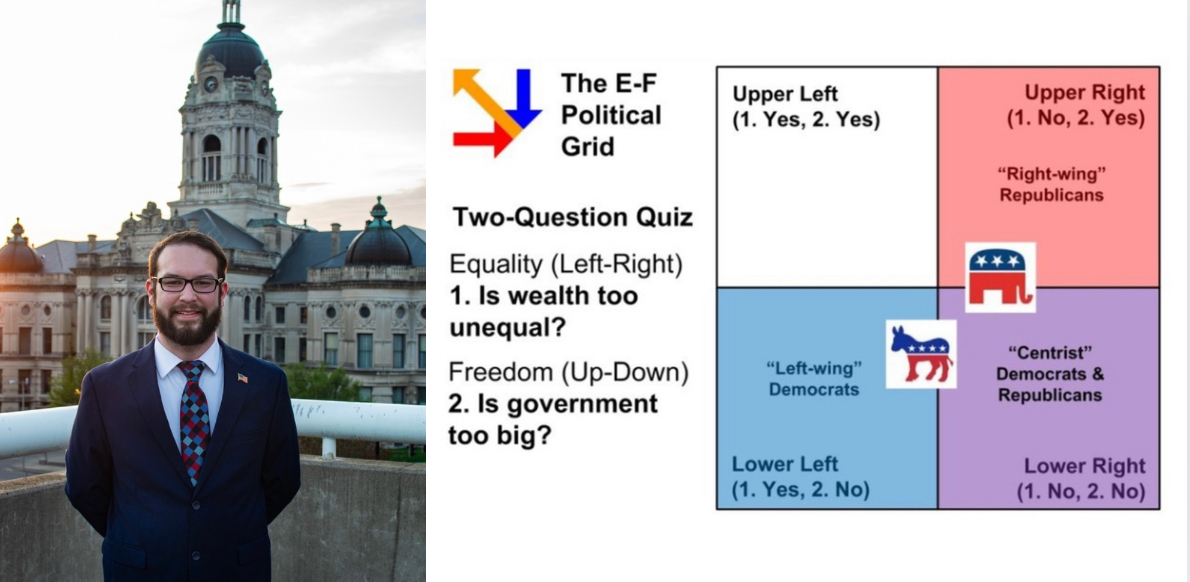
Depending on how one answers these two questions, specifically when asked together, one can place themselves within one of four quadrants, which are labeled Upper-Left, Upper-Right, Lower-Left, and Lower-Right; that make up the E-F Model. Within these quadrants, one can also find the two major political parties and the so called “uniparty.” One may ask, “Where are the Independents?” to which we respond, “Why don’t we take a look at the one quadrant that has no political party, the Upper-Left,” which is the key insight that the E-F Model offers.
Analyzing TIPP Poll Results:
As mentioned at the beginning of this article, Sloan commissioned a poll by TIPP to test whether or not the E-F Model proved to be accurate and to see if Independents truly belong in the Upper-Left quadrant, and here is what the data shows.
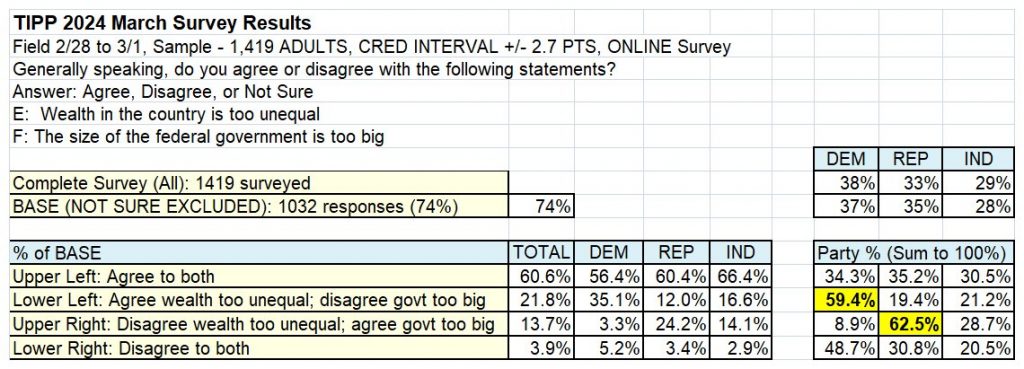
According to the data, 61% of respondents placed themselves in the Upper-Left quadrant, meaning they agreed that both the wealth is too unequal, and that the government is too big. Out of that 61% of total respondents, 66% of Independents, 60% of Republicans, and 56% of Democrats identified as Upper-Left, which was both unexpected and is statistically significant. Perhaps this can explain the fracturing of both parties? Additionally, it can be confirmed here that most Independents do in fact belong in the Upper-Left quadrant as hypothesized.
As for the other two quadrants, it is shown that Democrats (60% of LL) clearly dominate the Lower-Left, and that Republicans (63% of UR) clearly dominate the Upper-Right, which proves their placement on the model to also be correct. As for Lower-Right, where the “uniparty” comes together (bipartisanship) to agree with the idea that wealth is not too unequal and that the government is not too big, it is shown that only 4% of total respondents identify with this quadrant. This makes the Lower-Right the smallest quadrant while the Upper-Left remains the largest, making them stark contrasts of one another.
Where Opportunity Lies:
As mentioned previously, the Upper-Left is the only quadrant where a political party does not currently exist; therefore, it can be argued that the Upper-Left is the ideal place to start a new, viable third party. Perhaps this explains why the third-party/independent movement has not been successful up until this point, for they have yet to tap into this unknown demographic. We have reason to believe that the Green Party is of the Lower-Left and that the Libertarian Party is of the Upper-Right, and this is may explain why they have not been successful; however, further polling must be conducted to test this. It can also be argued that the way to unite the country is by moving those in the Lower-Left towards freedom (smaller government) and those in the Upper-Right towards equality (more equal wealth), essentially uniting them through policies of compromise.
Final Thoughts & Further Research:
In conclusion, the E-F Model developed by Lloyd Sloan proves to be a better fit in explaining the two-party system, Independents, and the “uniparty” than the current standard “Left vs Right” model taught by professors in universities nationwide. In order to test this further, we must continue conducting polls not only to ask these two questions, but also to ask questions regarding “Upper-Left” policies that reduce government and reduce wealth inequality. We must specifically ask these questions amongst Democrats, Republicans, Independents, Greens, Libertarians, etc. for further analysis. Only then can we truly dive further into what could be considered the new center in American politics. Could this lead to a new party forming in the Upper-Left, which could potentially break the two-party system, or could it realign the current parties and bring us back to a time of smaller government and more equal wealth?
Leave a Reply