By: Andrew Cottingham
University of Evansville Alumni (2022)
Date: May 14th, 2024
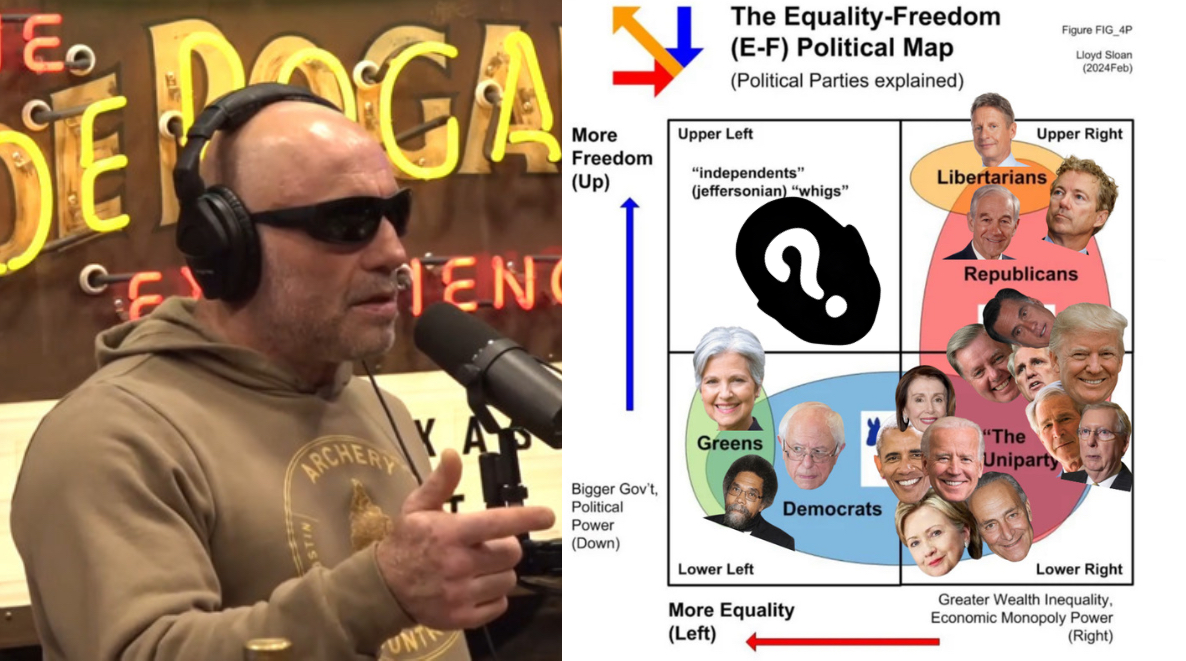
In episode #1693 of The Joe Rogan Experience, which aired on Spotify on August 6th, 2021, Joe Rogan describes himself and many Americans as being politically homeless, a term often applied to people who feel little or no attachment to a political party or ideology, which are also typically found to be Independent voters.
When asked by Evan Hafer whether or not he has a political party and ideology he fits into, Rogan stated “definitely not. No, I am just a homeless person when it comes to politics. I am liberal in every social way… I’m very liberal in terms of civil rights, gay rights, women’s’ rights, and all those core issues that make a person a progressive. I’m very much in line with that. I also have a lot of guns. I’m also a hunter. I’m very pro Second Amendment. I’m also very pro-military, very pro-police, very pro-first responders, and pro-fire department. I think you need discipline and authority… I have a deep respect for them, so that puts me in Conservative-land. I’m very conservative in that regard. I’m very conservative in that I believe in discipline”[1] In a way, both Rogan and Americans who identify as either Independent or third-party find themselves stuck in the center; therefore, further understanding this center may both unlock their true political identity and establish a new homestead for said identity, which we argue lies in the Upper-Left position.
According to a Gallup poll conducted last year, 43% of respondents identified as Independents in 2023.[2] This leaves Independents entering 2024 with the largest voter base in comparison to the two-major parties, who according to the poll, only share an equal 27% shares of U.S. adults.[2] This means that only 27% of U.S. adults identify as Democrats, and only 27% of U.S. adults identify as Republicans; meanwhile, 43% of U.S. adults identify as Independents, which could grow as the 2024 election cycle continues to move forward. That also leaves 3% open to third-party members, who were not studied in the poll. The questions we must ask ourselves now are quite simple. Who are the Independents, who are the politically homeless, and where do they belong? We will use Joe Rogan as an example.
From Leftist Beginnings:
Having grown up in San Francisco, lived on the East Coast, lived in Los Angeles, and now residing in Austin, Texas, 56-year-old comedian, UFC commentator, and world-renowned podcast host Joe Rogan now finds himself at a political crossroads, for he is politically homeless. When describing his childhood, Rogan has explained on several occasions that he was born to liberal parents in era of counterculture during the 1960s and 70s, a time when being liberal meant you were anti-war, anti-censorship, and pro-freedom according to Rogan. During a more recent episode on “Protect Our Parks 11,” which aired on Spotify on March 20th, 2024, Rogan states that “I would consider myself on the left for most of my life until I was in my late forties. … The plot was supposed to be free speech, open dialogue, communication, and acceptance of all people”[3] Since his departure from the left, Rogan has been smeared as a far-right conservative or right-wing extremist despite engaging in open dialogue with guests from all across the political spectrum.
For example, Rogan has spoken with many left-leaning guests such as Bernie Sanders, Andrew Yang, Kyle Kulinski, Krystal Ball; meanwhile, Rogan has also spoken to right-leaning guests such as Ben Shapiro, Jordan Peterson, Candace Owens, Matt Walsh, Steven Crowder, Saagar Enjeti, etc. As for Independents, excluding Bernie Sanders, Rogan has also interviewed Tulsi Gabbard and Robert F. Kennedy Jr., who have both left the Democratic Party; additionally, Rogan has also interviewed third party guests such as Dave Smith, a libertarian commentator. Even after all these interviews, and as a result of having both liberal and conservative beliefs, Rogan still cannot pinpoint where exactly he fits on the current “Left vs Right” political spectrum, which I have explained in another article I wrote titled “Young Political Scientist Helps Build Case for New Political Map with TIPP Poll Results.”
The E-F Model:
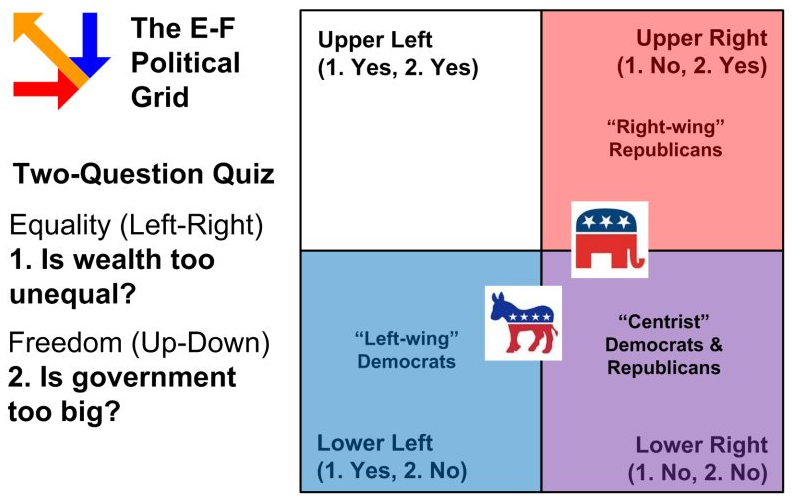
In this article, not only do I break down why the current “Left vs Right” political spectrum model and other models such as the Political Compass are greatly insufficient, but I also introduce a new model called the E-F Model, created by Lloyd Sloan. Lloyd and I met while volunteering for RFK Jr.’s presidential campaign, where he introduced me to the concept, and it deeply intrigued me almost immediately. To summarize the article and concept, the E-F Model is based on two key principles, which are equality (measured by wealth inequality), and freedom (measured by size of government). In order to define oneself with these parameters, one must ask themselves these two questions.
Is the wealth in the U.S. too unequal?
Is the U.S. government too big?
As I state in the article, “depending on how one answers these two questions, specifically when asked together, one can place themselves within one of four quadrants, which are labeled Upper-Left, Upper-Right, Lower- Left, and Lower-Right; that make up the E-F Model”[4] Before developing my case for him any further, I would like to ask Joe Rogan these questions and see where he falls on the E-F Model.
Where do Rogan and the Politically Homeless Fit?
Having listened to The Joe Rogan Experience for over five years now, I have reason to believe and make a claim that Joe Rogan is still a leftist, but an Upper-Leftist at that. Let me explain. Throughout the years, Rogan has been a strong advocate towards smaller government, a freer market, and greater individual freedom, which places him up on the E-F Model. Additionally, Rogan, who is independently wealthy himself, has clearly shown concern and has brought awareness towards both the ever-increasing wealth inequality and concentration of wealth in the U.S., which places him on the left according to the E-F Model. As a result, it is reasonable to suggest that Joe Rogan is in fact an Upper-Leftist; however, only he can confirm or deny this claim. In a recent interview with Neal Brennan, Rogan did state that “I’m pretty liberal. I’m just liberal as in what a liberal used to be. I don’t even lean more to the right, I lean more center, which is right now. The left has gone so far to the left.”[5] Perhaps the Upper-Left position is the new center in American politics that Rogan and others are searching for?
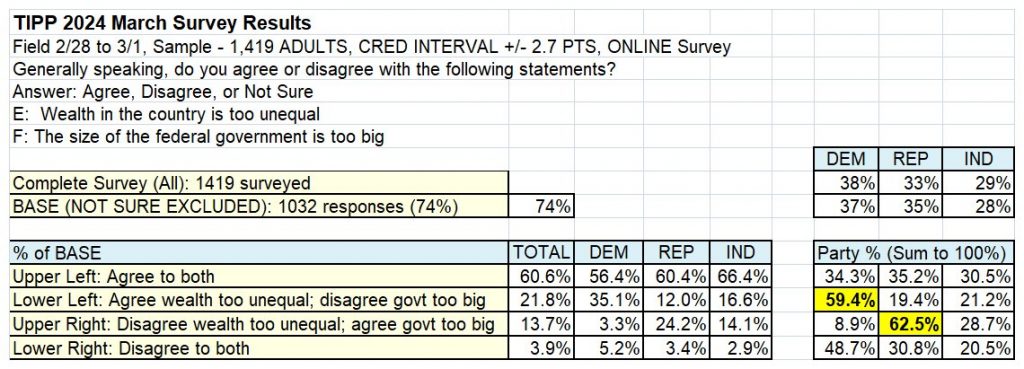
As for others who describe themselves as “politically homeless” the data shows that they too are highly likely to fit within the philosophy of the Upper-Left. According to the TIPP poll, which is further explained in my previous article, we found that “61% of respondents placed themselves in the Upper-Left quadrant, meaning they agreed that both the wealth is too unequal, and that the government is too big. Out of that 61% of total respondents, 66% of Independents, 60% of Republicans, and 56% of Democrats identified as Upper-Left”[6]Perhaps this can explain exactly where the “politically homeless” are and why the two-party system no longer suits them. They are predominantly Upper-Left while the system is Lower-Right. “What is the solution?” you may ask. Either a new Upper-Left political party, a new homestead for the politically homeless, or an Upper-Left realignment of the two-party system.
Sources:
[4,6] Cottingham, Andrew. “Young Political Scientist Helps Build Case for New Political Map with TIPP Poll Results.” X (Twitter), 14 May 2024.
[1] Rogan, Joe, Host, “Evan Hafer.” The Joe Rogan Experience, episode 1693, Spotify, 6 August 2021.
[5] Rogan, Joe, Host, “Neal Brennan.” The Joe Rogan Experience, episode 2135, Spotify, 12 April 2024.
[3] Rogan, Joe, Host, “Protect Our Parks 11.” The Joe Rogan Experience, episode 2122, Spotify, 20 March 2024.
[2] Jones, Jeffrey M. “Independent Party ID Tied for High; Democratic ID at New Low.”Gallup.Com, Gallup, 6 March 2024.
.
Leave a Reply