Month: January 2026

  • Mapping the Loss of Equality & Freedom in the United States (1947-2023)

    Mapping the Loss of Equality & Freedom in the United States (1947-2023)

    By: Andrew Cottingham
    University of Evansville Alumni (2022)
    Date: March 12th, 2025

    Equality and freedom, two fundamental principles enshrined in the Declaration of Independence and the U.S. Constitution, have been on a steady decline in the United States since 1776, especially during the 20th and 21st century in the aftermath of World War Two. In order to recognize said decline, one must first understand how to measure it and chart it. In this article, we will not only define how to measure both equality and freedom in the United States, but we will also chart it, analyze it, and draw conclusions from it as well.

    The methodologies used to measure and map equality and freedom, and the political concepts found within this article, were developed by my friend Lloyd Sloan, who I have written about in my previous works on this topic. My purpose is to further expand upon his initial research, which can be accomplished by studying the original concept, updating and building upon it, and by correlating it with the data we have collected in our studies of the Equality-Freedom Model. In doing so, we can accurately define the direction in which the country is currently heading in, and we can define the direction in which the country should be heading instead.
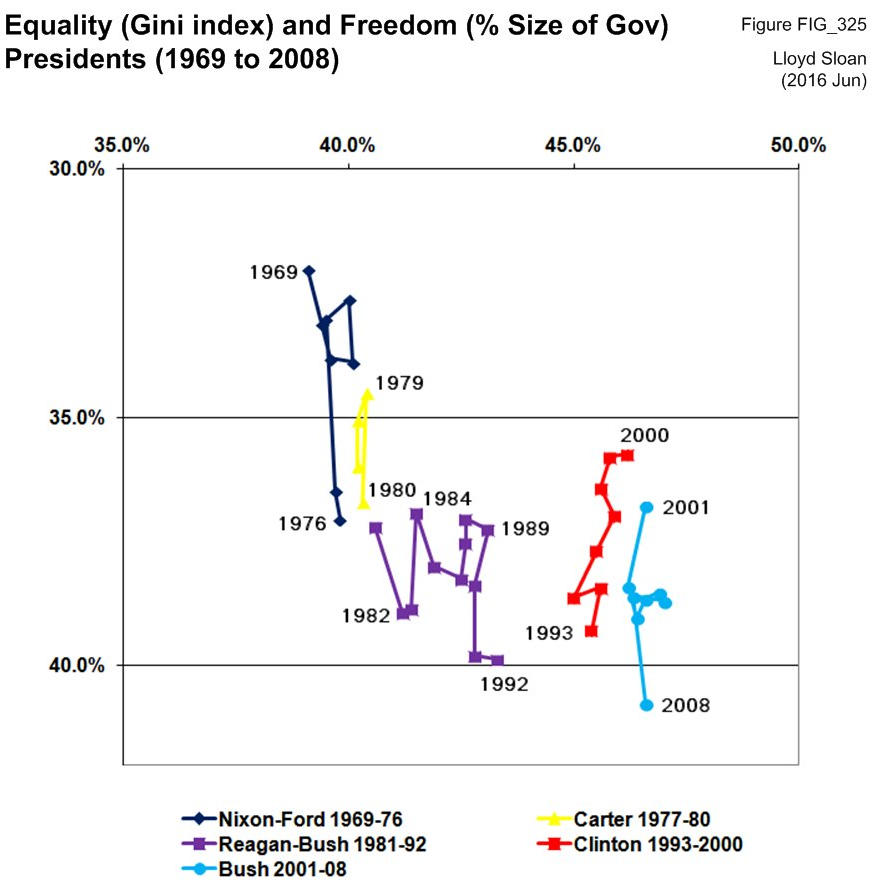
    Figure 1: Original timeline chart created by Lloyd Sloan in 2016

    Original 2016 Chart (1969-2008):

    The initial chart (above), created by CULP Founder Lloyd Sloan in 2016, demonstrates how the Gini Index and federal spending, specifically as percentage of GDP, have fluctuated in the United States between 1969 and 2008. Sloan also separates the timeline by representing each presidential administration from President Nixon starting in 1969 and ending with President George W. Bush at the end of his second term in 2008. In this chart, Sloan utilizes the Gini Index as a measurement of equality (x-axis), specifically wealth inequality, in the United States. Sloan also utilizes federal spending as percentage of GDP as a measurement of freedom (y-axis) in the United States.

    Note that both variables can have either a positive or negative relationship with their respected label; for example, as the Gini Index decreases and moves from right to left on the x-axis, then equality increases. If federal spending as a percentage of GDP decreases and moves up on the y-axis, then freedom also increases. As a result, the more the graph shifts upwards and to the left, the freer and more equal the United States becomes.

    On the contrary, if the Gini Index increases, moving left to right on the x-axis, equality decreases; additionally, if federal spending as a percentage of GDP increases, moving down on the y-axis, freedom also decreases. As a result, the more the graph shifts downwards and to the right, the less free and equal the United States becomes.

    By plotting a point (equality, freedom) for each year, one can create a timeline that can reveal the direction of the country over a period of time, which we can then utilize to analyze the decline of equality and freedom in the United States. Once the initial timeline is established, it can then be analyzed by considering several political and non-political factors. These factors include but are not limited to differing Presidential administrations, party control over Congress, election years, economic downturn (recessions & depressions), market crashes, conflict (domestic & abroad), etc. This topic will be explored in greater detail in the next section.

    To sum up Sloan’s initial 2016 chart, it shows that both equality and freedom in the United States have certainly been in decline since 1969 under both Republican and Democratic administrations. In fact, according to this chart, the American people were more equal in wealth and freer in 1969 than in 2008. Overall, this timeline proves that the general direction of the country between 1969 and 2008, a period of almost 40 years, shifted downwards and to the right.
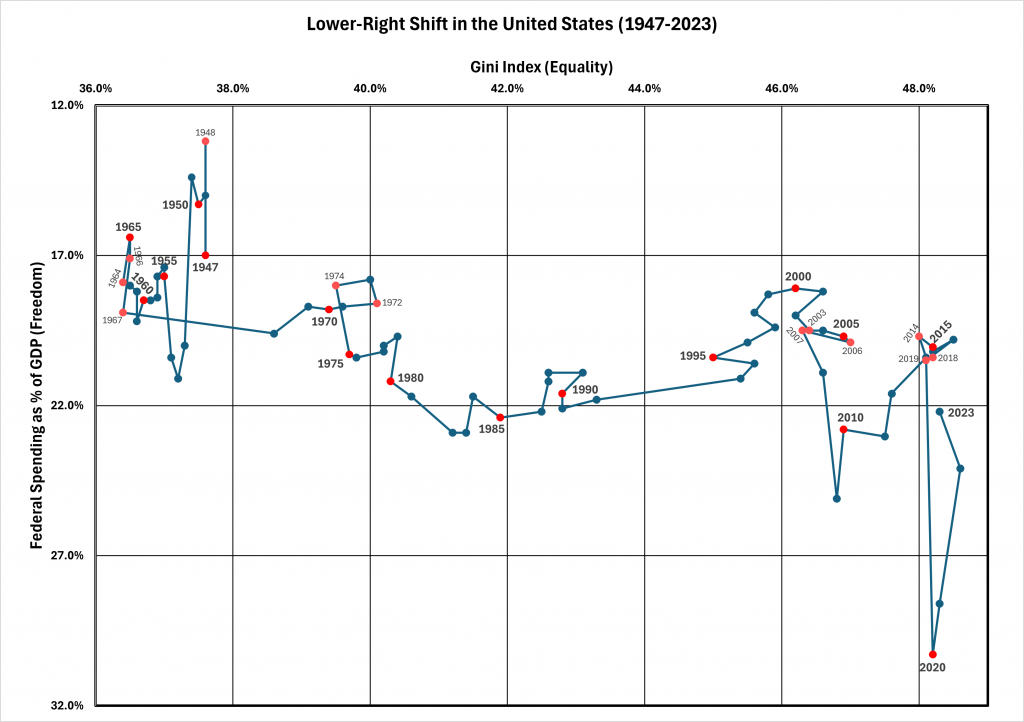
    Figure 2: Updated timeline chart created by me, Andrew Cottingham, in February 2025.

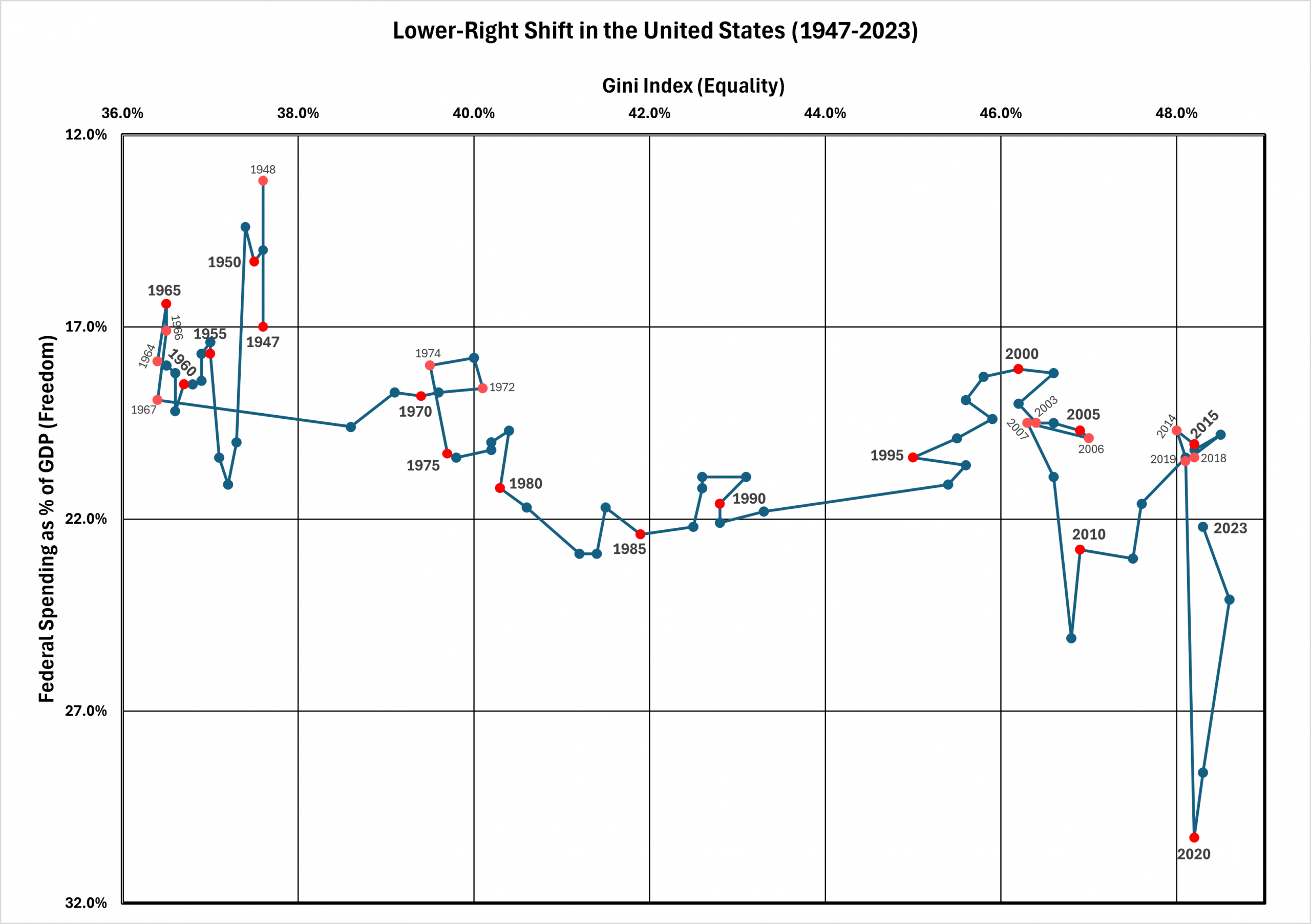
    Updated 2025 Chart (1947-2023):

    Since 2016, when Sloan’s initial chart was created, it has required recent updates to the data set, which I updated last month and compiled into this new chart (above). Not only did I decide to update the data to include the Gini Index and federal spending as percentage of GDP from 2009-2023, but I also took it a step further and included the data from 1947-1968 as well. While the addition of the data from the Obama, Trump, and Biden administrations was essential for modern analysis, I also chose to include the administrations of President Truman, Eisenhower, Kennedy, and Johnson for historical analysis. By expanding the timeline, one can further analyze the decline of equality and freedom in the United States since World War II, which this graph and its predecessor both accurately map.

    Notable Events

    • Post-WWII U.S. Production Adjustment (1947-49)
    • Korean War (1950-1953)
    • Vietnam War (1955-1975)
    • Recession (1973-1975)
    • Recession (1980-1982)
    • Gulf War & Recession (1990-1991)
    • 9/11 & War on Terror (2001)
    • Iraq War (2003-2011)
    • The Great Recession (2007-2009)
    • COVID-19 Pandemic (2019-2023)

    As mentioned in the previous section, the general direction of the country displayed in this updated timeline has continued to shift downwards and to the right. When comparing the two charts, one can immediately find that the charts are identical between 1969-2008, and that is due to the fact that they use the same data as expected. Additional insight can be found outside of that 39-year window; for example, from 1947-1967, in just 20 years, the country actually shifted downwards and to the left rather gradually. This was quite surprising to discover. Based on the timeline, the downward shift to the right must have started again after 1967. Another notable period is between 2007-2009, which was the Great Recession, where we saw a significant downward shift to the right; however, this would later be overshadowed by the COVID-19 pandemic. During the COVID-19 pandemic, which started in late 2019 and ended in 2023, the United States experienced the greatest loss of equality and freedom since World War Two. During this period, we witnessed an incredible amount of wealth shift from the bottom to the top alongside a significant increase in both government spending, regulation, and overreach.
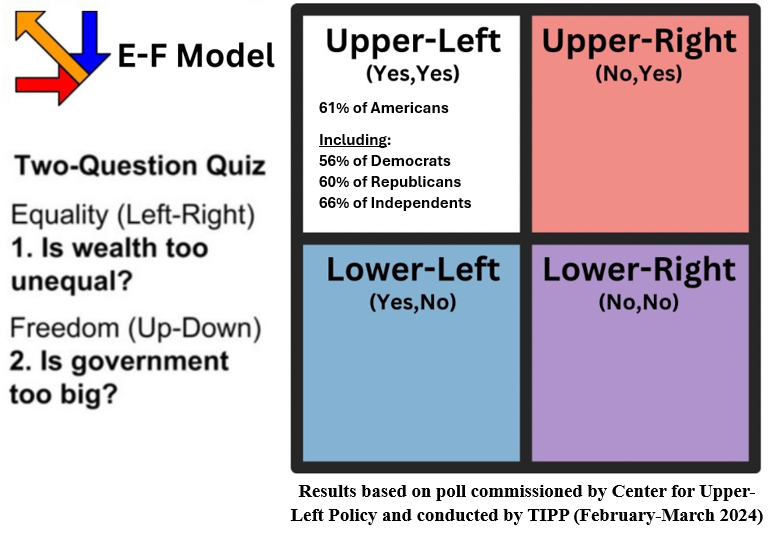
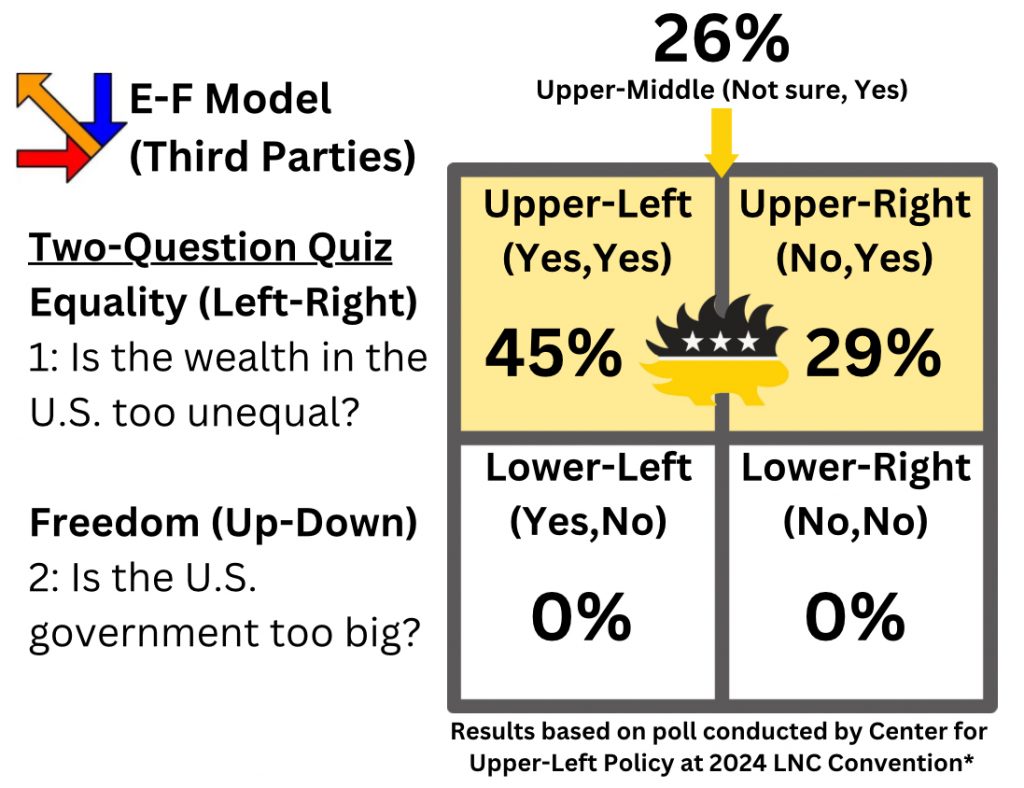
    Figure 3: E-F Model with TIPP poll (February-March 2024) results listed.
    Figure 4: E-F Model with results from CULP poll conducted at 2024 LNC listed.

    Additional Support for the E-F Model:

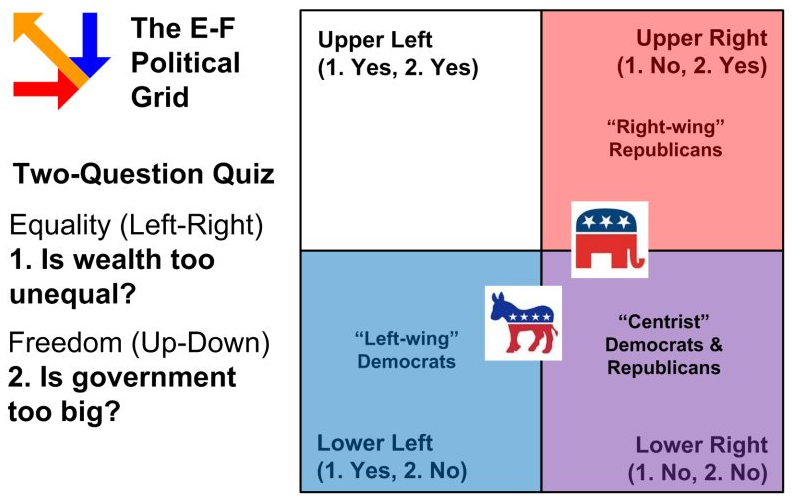
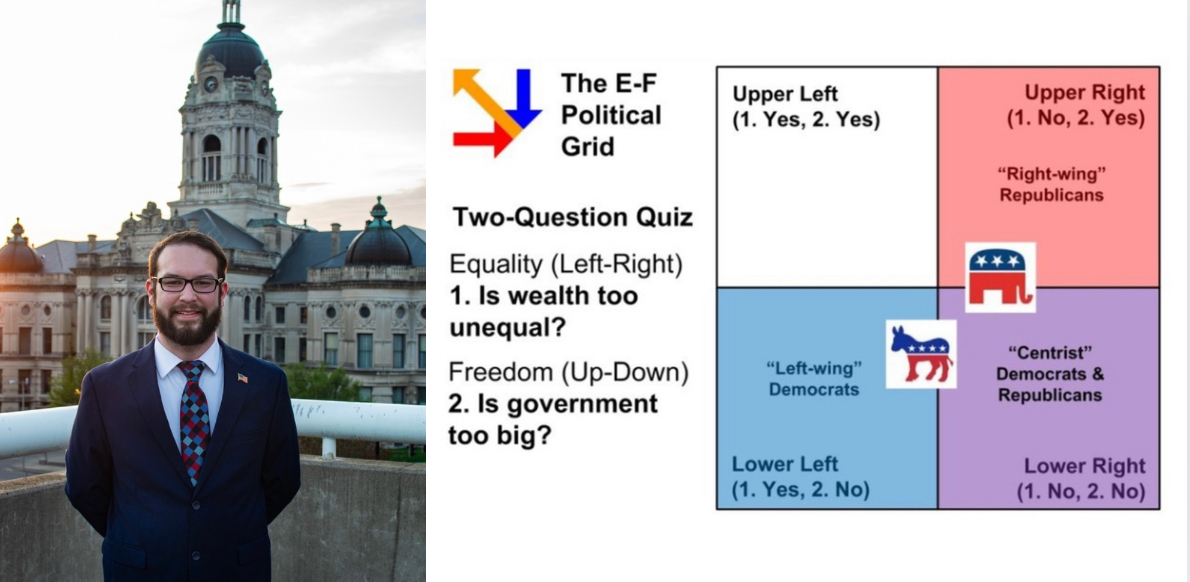
    In previous articles, I have written about the Equality-Freedom Model (Figure 3), a new political map also created by Lloyd Sloan. Since being introduced to the concept, I have assisted Lloyd in updating old data, gathering new data, and gaining additional insight into his original concepts. To sum up the E-F Model, it is a two-dimensional political grid that is separated into four quadrants labeled Upper-Left, Upper-Right, Lower-Left, and Lower-Right, which are shown above. Which quadrant a person is placed in is solely determined by how they answer these two fundamental questions relating to equality and freedom. 1) Is wealth too unequal? 2) Is the government too big?

    For more in-depth analysis of the E-F Model, please consider reading these articles below:

    Having gathered and analyzed polling data from Democrats, Republicans, and Independents (Figure 3), and Libertarians (Figure 4) throughout 2024, we recognized that updating the timeline was our next objective as we wait for our poll with the Green Party to conclude. As valuable as our polling data is for supporting the merit of the E-F Model and the insight gained from it, we also recognized that updating the timeline was also essential, for it is additional supporting evidence for the E-F Model. Afterall, the timeline clearly shows that the country is heading in a Lower-Right direction, which is explained by the E-F Model. Lower-Right means greater wealth inequality and more government, which means less freedom. Meanwhile, the E-F Model and the data supporting it suggests which direction the American people want to take the country in an Upper-Left direction. Upper-Left means greater equality and less government, which means more freedom. It turns out that direction crosses all party lines except for the uniparty, which aligns itself in the Lower-Right. Once we can define and recognize which direction we have been heading, we can then decide how we want to change our course moving forward.

    A New Direction for the Country:

    In conclusion, the decline of both equality and freedom in the United States since can be accurately mapped, analyzed, and defined by the data within these two charts, which also support the insights initially made through the E-F Model. Not only do these charts prove that the United States has been heading in a downward direction to the right (Lower-Right), but they can also help us further understand why the country has been heading in that direction on a contemporary and historical level of analysis.

    Additionally, both of these charts and the E-F Model also provide us with a new direction to take the country in, which is in an upward direction to the left (Upper-Left). This direction emphasizes an approach to shrinking government as a means to increase freedom, but in a way that also decreases wealth inequality; therefore, reversing the decline of both equality and freedom in the United States. Of course, this just scratches the surface of the concept, for the true task at hand will be drafting policies for doing so and implementing them throughout our local, state, and federal government.


    Sources:

    1. Federal Reserve Economic Data (FRED)

    FRED offers Gini Index values for the U.S. from 1967 to recent years, with consistent annual data updated by the World Bank and other sources. (Fred Gini Index Series)

    2. Our World in Data

    This platform provides historical data visualizations and datasets on economic inequality, including income distribution and Gini coefficients, covering various decades. (Our World in Data)

    3. Scholarly Estimates for Early Years (1947-1963)

    Since official annual Gini Index data before 1967 is sparse, estimates for 1947–1963 are derived from historical economic studies and reconstructions of income inequality trends in the post-WWII era.

    Primary Study: Goldin, Claudia, and Katz, Lawrence. “The Shaping of Postwar Income Distribution in the United States.”

    Secondary Source: Piketty, Thomas, and Saez, Emmanuel. “Income Inequality in the United States, 1913–1998.”

    4. U.S. Census Bureau

    The Census Bureau provides historical Gini Index data for households and families starting from 1947. Their reports cover trends in income inequality and offer annual Gini estimates based on family income. (US Census Bureau Gini Index Tables 2010-2023)

    5. U.S. Federal Spending as % of GDP (1947-2023)

    Secondary Source: https://www.usgovernmentspending.com

    Data Set for Updated Chart
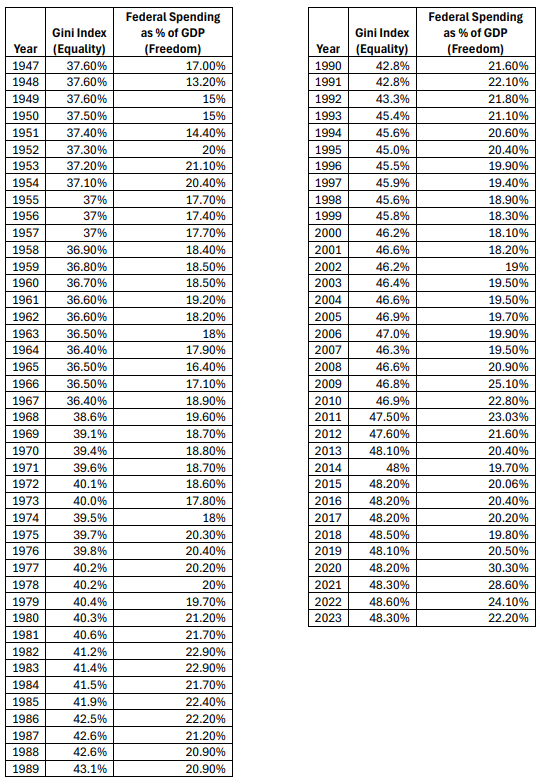
    Data derived from multiple sources. (Listed above)
  • Center for Upper-Left Policy Finds Left/Right Divide Amongst Libertarians at 2024 LNC

    Center for Upper-Left Policy Finds Left/Right Divide Amongst Libertarians at 2024 LNC

    By: Andrew Cottingham
    University of Evansville Alumni (2022)
    Date: May 14th, 2024

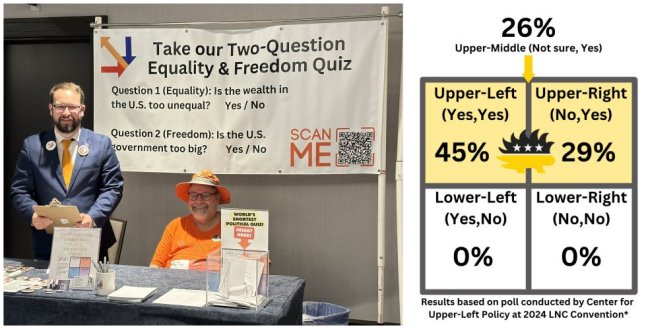
    During the 2024 Libertarian National Convention, which was held in Washington D.C. between May 23-26th, Lloyd Sloan and Andrew Cottingham, on behalf of the Center for Upper-Left Policy, conducted a poll of over 100 Libertarians attending the convention. Amongst these 100 Libertarians were party members, state delegates, party leaders, candidates, and celebrities including comic and political commentator Dave Smith.

    The purpose of this poll was to accurately place the Libertarian Party on the E-F Model (below*), an emerging two-dimensional political map. This model is broken down into four quadrants, which are labeled as Upper-Left, Upper-Right, Lower-Right, and Lower-Left as shown below. As explained in my other two articles, “Young Political Scientist Helps Build Case for New Political Map with TIPP Poll Results” and “The Upper-Left Position: A New Homestead for What Joe Rogan Calls the Politically Homeless,” one’s placement on the E-F Model is determined by how they answer these two questions regarding to equality and freedom.

    Is the wealth in the U.S. too unequal?
    Is the U.S. government too big?

    (The E-F Model as of 2024)

    The Need to Study Third Parties

    Prior to our poll conducted at the Libertarian National Convention, we commissioned a national poll with the TechnoMetrica Institute of Policy and Politics back in February and March, which not only solidified the case for the accuracy of the E-F Model, but also further expanded upon its initial insights. (See previous articles for results

    As a follow-up to our national poll, which did not include third parties such as the Libertarian Party and the Green Party, both Lloyd and I decided to attend the only event where we could accurately poll their members, their national party’s convention. National pollsters typically do not ask for third-party identification due to their statistical insignificance in random survey polling; however, by attending their convention, where there is a high concentration of party members, one can effectively poll this otherwise small demographic rather accurately.

    Our Results & Third-Party Map

    Over the course of four days, and as previously mentioned, over 100 self-identified Libertarians stopped by our booth to take our two-question quiz and help us put the Libertarian Party on the map. Here are the final results. The consensus on the size of government (freedom) question was unanimous amongst all Libertarians polled, which was found to be specifically unique to the Libertarian Party when compared to Democrats, Republicans, and Independents. Every Libertarian polled agreed that the size of the U.S. government is too big, which was to be expected.

    (Poll Conducted May 23-26, 2024)

    However, the question regarding wealth inequality (equality) was where differences in opinion began to appear amongst Libertarians. According to our poll, 45% of Libertarians agreed that the wealth in the United States is too unequal (Upper-Left); on the contrary, 29% of Libertarians disagreed (Upper-Right). In addition to what we would call the Left vs Right divide on the question of wealth inequality, we also found that 26% of Libertarians were left undecided (Upper-Middle) on that question as well.

    Many argued that wealth shouldn’t be equal, which isn’t what the question is asking, while others argued that government interference and entanglement in the free market are to blame for the wealth inequality. In addition to this, many respondents were initially confused by the E-F Model and had acquainted it with the Political Compass and the Nolan Chart, which are commonly used amongst Libertarians both young and old. Having learned this, we have determined that distinguishing the E-F Model from the Political Compass and Nolan Chart will be our next task following this study.

    What does this mean for the Libertarian Party?

    What this shows is that the Libertarian Party is split in three ways on the issue of wealth inequality in the United States, where 26% of the party has the potential to be persuaded to either side, which perhaps explains why there is such division and dysfunction within the party itself. Considering that our TIPP poll shows that “61% of the American people, including 56% of Democrats, 60% of Republicans, and 66% of Independents can be classified as Upper-Left,”[1] the greatest opportunity for the Libertarian Party to grow lies within their decision to embrace their inner 45% by promoting Upper-Left policies and candidates.

    Upper-Left Policies: Policies that both shrink government and reduce wealth inequality.

    • Freeze government spending.
    • Audit/abolish the Federal Reserve.
    • Abolish the federal/state income tax on all overtime pay.
    • Increase the federal/state income tax exemption standard to $50k, $75k, or $100k. (Bottom-up tax cuts, not top-down)
    • Abolish the sales tax on groceries/produce, medicine/vitamins, clothing, and additional healthcare products. (Necessities)
    • Implement a “negative income tax” in place of UBI and to reform/consolidate the welfare state. (Options: Accept payout or exchange for food/medicine/housing/education vouchers at a 2:1 ratio)
    • Stop U.S. funding/military aid to Ukraine & Israel.
    • Leave NATO.

    With 26% of the party left undecided on wealth inequality, there is also the opportunity to further expand upon that initial 45% as well. Perhaps moving the party in an Upper-Left direction can both unite the party and make it more competitive against Democrats, Republicans, and even other third-parties. By tapping into this unrepresented demographic, the Upper-Left, the Libertarian Party may finally break through the 1-4% threshold they have been stuck at for well over 50 years.

    Source:

    [1] Cottingham, Andrew. “Young Political Scientist Helps Build Case for New Political Map with TIPP Poll Results.” X (Twitter), 14 May 2024.

  • The Upper-Left Position: A New Homestead for What Joe Rogan Calls the “Politically Homeless”

    The Upper-Left Position: A New Homestead for What Joe Rogan Calls the “Politically Homeless”

    By: Andrew Cottingham
    University of Evansville Alumni (2022)
    Date: May 14th, 2024

    In episode #1693 of The Joe Rogan Experience, which aired on Spotify on August 6th, 2021, Joe Rogan describes himself and many Americans as being politically homeless, a term often applied to people who feel little or no attachment to a political party or ideology, which are also typically found to be Independent voters.

    When asked by Evan Hafer whether or not he has a political party and ideology he fits into, Rogan stated “definitely not. No, I am just a homeless person when it comes to politics. I am liberal in every social way… I’m very liberal in terms of civil rights, gay rights, women’s’ rights, and all those core issues that make a person a progressive. I’m very much in line with that. I also have a lot of guns. I’m also a hunter. I’m very pro Second Amendment. I’m also very pro-military, very pro-police, very pro-first responders, and pro-fire department. I think you need discipline and authority… I have a deep respect for them, so that puts me in Conservative-land. I’m very conservative in that regard. I’m very conservative in that I believe in discipline”[1] In a way, both Rogan and Americans who identify as either Independent or third-party find themselves stuck in the center; therefore, further understanding this center may both unlock their true political identity and establish a new homestead for said identity, which we argue lies in the Upper-Left position.

    According to a Gallup poll conducted last year, 43% of respondents identified as Independents in 2023.[2] This leaves Independents entering 2024 with the largest voter base in comparison to the two-major parties, who according to the poll, only share an equal 27% shares of U.S. adults.[2] This means that only 27% of U.S. adults identify as Democrats, and only 27% of U.S. adults identify as Republicans; meanwhile, 43% of U.S. adults identify as Independents, which could grow as the 2024 election cycle continues to move forward. That also leaves 3% open to third-party members, who were not studied in the poll. The questions we must ask ourselves now are quite simple. Who are the Independents, who are the politically homeless, and where do they belong? We will use Joe Rogan as an example.

    From Leftist Beginnings:

    Having grown up in San Francisco, lived on the East Coast, lived in Los Angeles, and now residing in Austin, Texas, 56-year-old comedian, UFC commentator, and world-renowned podcast host Joe Rogan now finds himself at a political crossroads, for he is politically homeless. When describing his childhood, Rogan has explained on several occasions that he was born to liberal parents in era of counterculture during the 1960s and 70s, a time when being liberal meant you were anti-war, anti-censorship, and pro-freedom according to Rogan. During a more recent episode on “Protect Our Parks 11,” which aired on Spotify on March 20th, 2024, Rogan states that “I would consider myself on the left for most of my life until I was in my late forties. … The plot was supposed to be free speech, open dialogue, communication, and acceptance of all people”[3] Since his departure from the left, Rogan has been smeared as a far-right conservative or right-wing extremist despite engaging in open dialogue with guests from all across the political spectrum.

    For example, Rogan has spoken with many left-leaning guests such as Bernie Sanders, Andrew Yang, Kyle Kulinski, Krystal Ball; meanwhile, Rogan has also spoken to right-leaning guests such as Ben Shapiro, Jordan Peterson, Candace Owens, Matt Walsh, Steven Crowder, Saagar Enjeti, etc. As for Independents, excluding Bernie Sanders, Rogan has also interviewed Tulsi Gabbard and Robert F. Kennedy Jr., who have both left the Democratic Party; additionally, Rogan has also interviewed third party guests such as Dave Smith, a libertarian commentator. Even after all these interviews, and as a result of having both liberal and conservative beliefs, Rogan still cannot pinpoint where exactly he fits on the current “Left vs Right” political spectrum, which I have explained in another article I wrote titled “Young Political Scientist Helps Build Case for New Political Map with TIPP Poll Results.”

    The E-F Model:

    In this article, not only do I break down why the current “Left vs Right” political spectrum model and other models such as the Political Compass are greatly insufficient, but I also introduce a new model called the E-F Model, created by Lloyd Sloan. Lloyd and I met while volunteering for RFK Jr.’s presidential campaign, where he introduced me to the concept, and it deeply intrigued me almost immediately. To summarize the article and concept, the E-F Model is based on two key principles, which are equality (measured by wealth inequality), and freedom (measured by size of government). In order to define oneself with these parameters, one must ask themselves these two questions.

    Is the wealth in the U.S. too unequal?
    Is the U.S. government too big?

    As I state in the article, “depending on how one answers these two questions, specifically when asked together, one can place themselves within one of four quadrants, which are labeled Upper-Left, Upper-Right, Lower- Left, and Lower-Right; that make up the E-F Model”[4] Before developing my case for him any further, I would like to ask Joe Rogan these questions and see where he falls on the E-F Model.

    (The E-F Model as of 2024)

    Where do Rogan and the Politically Homeless Fit?

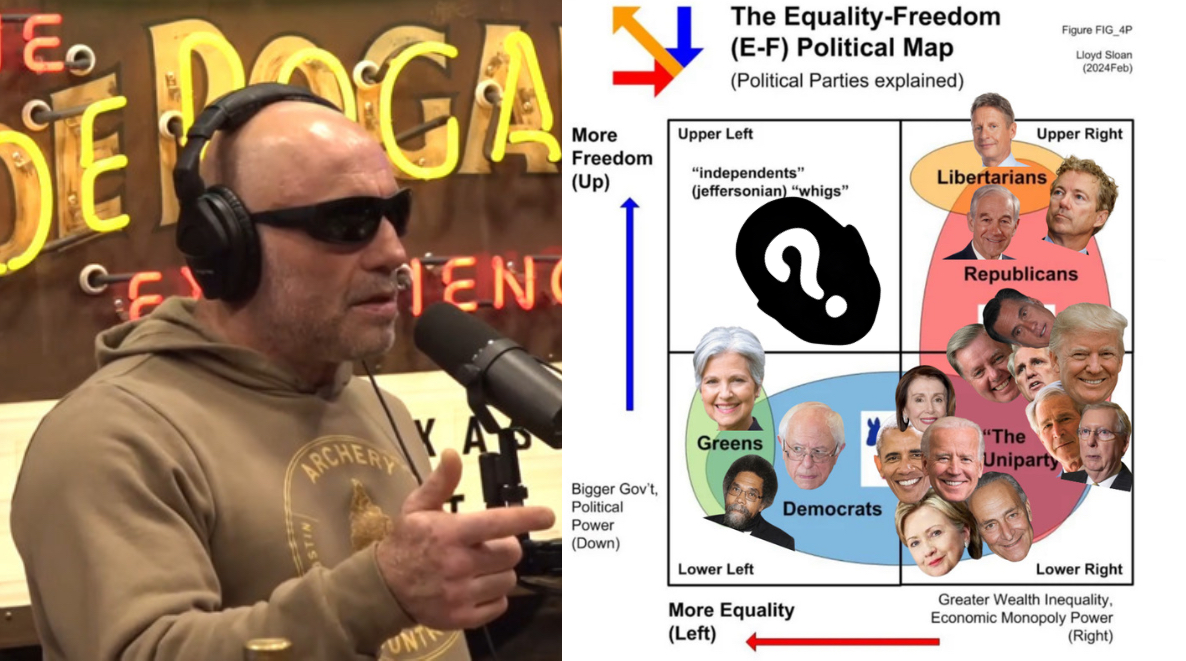
    Having listened to The Joe Rogan Experience for over five years now, I have reason to believe and make a claim that Joe Rogan is still a leftist, but an Upper-Leftist at that. Let me explain. Throughout the years, Rogan has been a strong advocate towards smaller government, a freer market, and greater individual freedom, which places him up on the E-F Model. Additionally, Rogan, who is independently wealthy himself, has clearly shown concern and has brought awareness towards both the ever-increasing wealth inequality and concentration of wealth in the U.S., which places him on the left according to the E-F Model. As a result, it is reasonable to suggest that Joe Rogan is in fact an Upper-Leftist; however, only he can confirm or deny this claim. In a recent interview with Neal Brennan, Rogan did state that “I’m pretty liberal. I’m just liberal as in what a liberal used to be. I don’t even lean more to the right, I lean more center, which is right now. The left has gone so far to the left.”[5] Perhaps the Upper-Left position is the new center in American politics that Rogan and others are searching for?

    (TIPP 2024 March Survey Results)

    As for others who describe themselves as “politically homeless” the data shows that they too are highly likely to fit within the philosophy of the Upper-Left. According to the TIPP poll, which is further explained in my previous article, we found that “61% of respondents placed themselves in the Upper-Left quadrant, meaning they agreed that both the wealth is too unequal, and that the government is too big. Out of that 61% of total respondents, 66% of Independents, 60% of Republicans, and 56% of Democrats identified as Upper-Left”[6]Perhaps this can explain exactly where the “politically homeless” are and why the two-party system no longer suits them. They are predominantly Upper-Left while the system is Lower-Right. “What is the solution?” you may ask. Either a new Upper-Left political party, a new homestead for the politically homeless, or an Upper-Left realignment of the two-party system.

    Sources:

    [4,6] Cottingham, Andrew. “Young Political Scientist Helps Build Case for New Political Map with TIPP Poll Results.” X (Twitter), 14 May 2024.

    [1] Rogan, Joe, Host, “Evan Hafer.” The Joe Rogan Experience, episode 1693, Spotify, 6 August 2021.

    [5] Rogan, Joe, Host, “Neal Brennan.” The Joe Rogan Experience, episode 2135, Spotify, 12 April 2024.

    [3] Rogan, Joe, Host, “Protect Our Parks 11.” The Joe Rogan Experience, episode 2122, Spotify, 20 March 2024.

    [2] Jones, Jeffrey M. “Independent Party ID Tied for High; Democratic ID at New Low.”Gallup.Com, Gallup, 6 March 2024.

    .

  • Young Political Scientist Helps Build Case for New Political Map with TIPP Poll Results

    Young Political Scientist Helps Build Case for New Political Map with TIPP Poll Results

    By: Andrew Cottingham
    University of Evansville Alumni (2022)
    Date: March 30th, 2024

    A new poll commissioned by Lloyd Sloan, Harvard ’78 graduate, and conducted by the TechnoMetrica Institute of Policy and Politics between February 28th and March 7th, 2024, strengthens the case for a new political map. This political map, which was first conceptualized by Sloan in 2013 and has since been developed, is referred to as the E-F Model or E-F Grid. The name E-F is derived from two key principles in American politics, those being equality and freedom, which are then measured, according to Sloan, by wealth inequality (equality) and size of government (freedom).

    The Standard “Left vs Right” Model:

    Before we examine the case for replacing the current political spectrum, which is taught nationwide by professors in every undergraduate political science program, we must first ask ourselves these questions. Why is the current model sufficient, why is it not, and how can it be improved?

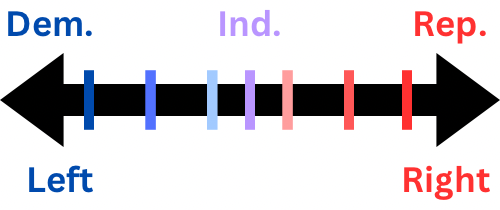
    In undergrad, we are taught that the political spectrum is linear, which is pictured here, and that it is divided into 7 categories amongst Democrats, Republicans, and Independents. In the classic “Left vs Right” model, you have strong Democrats, weak Democrats, and Democrat-leaning Independents on the left; meanwhile, you have strong Republicans, weak Republicans, and Republican-leaning Independents on the right.

    While this model showcases a surface-level understanding of political party identification, neither does it truly does explain why individuals identify themselves on the left or the right, nor does it explain why Independents identify themselves in the middle. Additionally, this model also fails to represent people who identify with third parties altogether. This is where the current Left-Right model and other models such as the Political Compass are greatly insufficient, and where the E-F Model is more sufficient.

    Introducing the E-F Model:

    Unlike the Political Compass, which lists over 60 questions, the E-F Model is based on two simple yes/no questions, where the core values of equality and freedom are tested. Additionally, while the Political Compass places freedom down, the E-F Model places freedom up. As previously mentioned, this model measures one’s opinion on equality (wealth inequality), and freedom (size of government) by asking these two questions below.

    Is the wealth in the U.S. too unequal?
    Is the U.S. government too big?

    Depending on how one answers these two questions, specifically when asked together, one can place themselves within one of four quadrants, which are labeled Upper-Left, Upper-Right, Lower-Left, and Lower-Right; that make up the E-F Model. Within these quadrants, one can also find the two major political parties and the so called “uniparty.” One may ask, “Where are the Independents?” to which we respond, “Why don’t we take a look at the one quadrant that has no political party, the Upper-Left,” which is the key insight that the E-F Model offers.

    (E-F Model as of 2024)

    Analyzing TIPP Poll Results:

    As mentioned at the beginning of this article, Sloan commissioned a poll by TIPP to test whether or not the E-F Model proved to be accurate and to see if Independents truly belong in the Upper-Left quadrant, and here is what the data shows.

    (TIPP 2024 March Survey Results)

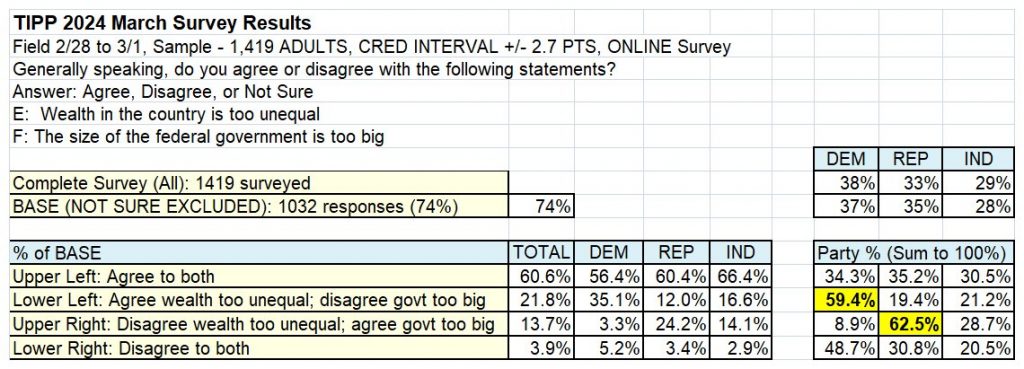
    According to the data, 61% of respondents placed themselves in the Upper-Left quadrant, meaning they agreed that both the wealth is too unequal, and that the government is too big. Out of that 61% of total respondents, 66% of Independents, 60% of Republicans, and 56% of Democrats identified as Upper-Left, which was both unexpected and is statistically significant. Perhaps this can explain the fracturing of both parties? Additionally, it can be confirmed here that most Independents do in fact belong in the Upper-Left quadrant as hypothesized.

    As for the other two quadrants, it is shown that Democrats (60% of LL) clearly dominate the Lower-Left, and that Republicans (63% of UR) clearly dominate the Upper-Right, which proves their placement on the model to also be correct. As for Lower-Right, where the “uniparty” comes together (bipartisanship) to agree with the idea that wealth is not too unequal and that the government is not too big, it is shown that only 4% of total respondents identify with this quadrant. This makes the Lower-Right the smallest quadrant while the Upper-Left remains the largest, making them stark contrasts of one another.

    Where Opportunity Lies:

    As mentioned previously, the Upper-Left is the only quadrant where a political party does not currently exist; therefore, it can be argued that the Upper-Left is the ideal place to start a new, viable third party. Perhaps this explains why the third-party/independent movement has not been successful up until this point, for they have yet to tap into this unknown demographic. We have reason to believe that the Green Party is of the Lower-Left and that the Libertarian Party is of the Upper-Right, and this is may explain why they have not been successful; however, further polling must be conducted to test this. It can also be argued that the way to unite the country is by moving those in the Lower-Left towards freedom (smaller government) and those in the Upper-Right towards equality (more equal wealth), essentially uniting them through policies of compromise.

    Final Thoughts & Further Research:

    In conclusion, the E-F Model developed by Lloyd Sloan proves to be a better fit in explaining the two-party system, Independents, and the “uniparty” than the current standard “Left vs Right” model taught by professors in universities nationwide. In order to test this further, we must continue conducting polls not only to ask these two questions, but also to ask questions regarding “Upper-Left” policies that reduce government and reduce wealth inequality. We must specifically ask these questions amongst Democrats, Republicans, Independents, Greens, Libertarians, etc. for further analysis. Only then can we truly dive further into what could be considered the new center in American politics. Could this lead to a new party forming in the Upper-Left, which could potentially break the two-party system, or could it realign the current parties and bring us back to a time of smaller government and more equal wealth?